Earlier this week The New York Times published an article about the potential economic impact and changing views about welfare and education subsidies granted Haredim (Ultra-Orthodox) in Israel. The article talks about JDC's Shahar program which, in coordination with the rabbis, assists Ultra-Orthodox men with professional training and has set up employment centers that cater to the specific needs and sensitivities of this population.
Read the full New York Times article at Some Israelis Question Benefits for Ultra-Religious.
You can also read an article featured in Haaretz last month about JDC's work with the Haredi population in Israel at Haredim moving from yeshiva to high-tech, through the army.


December 30, 2010
Photos from the Last JDC Ambassadors Circle Global Symposium of 2010
Thank you to everyone who attended the JDC Ambassadors Circle Global Symposium on December 13, 2010.
 |
| Stefan Oscar, JDC Area Director for Poland and the Baltic States, Karina Sokoloska, JDC Country Director for Poland and Zoya Shvartzman, Director of Resource Development for JDC-Europe discuss key issues within the Jewish communities of Europe today. |
 |
| Galit Sagie, Director of Planning and Development for JDC-Israel presents programs to benefit vulnerable populations in Israel through projects that promote enviromental sustainability. |
 |
| Will Recant, Assistant Executive Vice President holds a workshop on how to share JDC's story. |
 |
| JDC Ambassadors Circle Members, Izzet BenSusan (originally from Turkey), Dalia Cohen (originally from Zimbabwe) and Laurent Morali (originally from France) talk about why they left their home countries and the issues new immigrants face upon arrival in their new country. Sam Amiel, Executive for International Relations, moderated the panel. |
 |
| Danny Pins, Director of JDC's Immigrant Division for JDC-Israel, speaks on the topic, 'Israel's Future - Preventing Young Adults from Falling Through the Cracks'. |
 |
| Shauli Dritter, Director of Field Operations, JDC-FSU talks about JDC's role during crisis situations. |
 |
| Participants have a lunch-time discussion with Karina Sokolowska, JDC Country Director for Poland. |
 |
| Stefan Oscar, JDC Area Director for Poland and the Baltic States speaks more in depth about his region during the lunch session. |
 |
| Zoya Shvartzman, Director of Resource Development, JDC-Europe tells her story during the lunch session. |
 |
| Eliot Goldstein, Deputy Director for International Relations led an interactive session on 'Values and Dilemmas' in JDC's work. |
 |
| During the 'Values and Dilemmas' session, led by Eliot Goldstein, Deputy Director for International Relations, participants were asked to discuss one of five dilemmas based on real-world situations faced by JDC professionals. |
 |
| Sarah Hirschhorn, Division Director for Strategic Partnerships, JDC-Israel talks about the issues of mainstreaming Arab and Haredi populations into Israeli Society. |
 |
| "Making the Case - Storytelling, Framing and Telling the Overseas Story' -- a workshop with Michael Novick, Executive Director for Strategic Development. |
 |
| Shawn Landres, CEO and Co-Founder of Jumpstart presents on how Jewish innovation and social entrepreneurship are working to build a sustainable and viable Jewish future in Europe. |
 |
| Gideon Herscher, JDC Director of Haiti Relief Efforts talks about his own personal reflections on the months he spent on the ground in Haiti following the devastating Earthquake. |

December 23, 2010
Thoughts While Watching Paul Newman
In the latest post on her blog From Leslie's Laptop, Leslie Dannin Rosenthal, who serves as Vice Co-Chair of Major Gifts at the United Jewish Communities of MetroWest New Jersey reflects on the film Exodus (1960), Israel today and the 20th anniversary of Operation Exodus when thousands of Soviet Jews made Aliyah in the early 1990s.
Leslie also makes some nice remarks about her experience at the recent JDC Ambassadors Circle Global Symposium held on December 13 in New York. Thanks Leslie!
Read the full blog post at Exodus and Operation Exodus: Resounding in Head and Heart.
Leslie also makes some nice remarks about her experience at the recent JDC Ambassadors Circle Global Symposium held on December 13 in New York. Thanks Leslie!
Read the full blog post at Exodus and Operation Exodus: Resounding in Head and Heart.
December 22, 2010
Checkmate: JDC Uses Chess to Empower Immigrants
 Israel is considered a chess superpower, largely thanks to the massive immigration of over 1.1 million immigrants from the former Soviet Union, which brought some of the best players and coaches in the world to the country. Israel has six players ranked in the world's top 100; has 30 chess Grand Masters, with some of the highest concentrations of Grand Masters in the world.
The Israeli Chess Federation (ICF) – JDC's partner in this program – was founded in 1946 and today unites some 100 chess clubs around Israel. The ICF holds national league competitions in which 400 teams compete, representing over 4,000 registered chess players.
Chess and Education
The value of playing chess is well known. International research shows that chess has a positive influence on educational performance, improving both critical and creative thought. School students who study chess in a systematic way show improvements in numeric and verbal reasoning – leading to stronger reading and memory skills - within a year of starting chess.
Expanding Chess Playing Among the Young
JDC seeks to capitalize on the chess resources within Israel for the benefit of children and youth living in Israel's social periphery through the Checkmate! program, by introducing chess clubs in schools and youth centers. The program trains young adults with strong chess skills – in all likelihood, immigrants from the former Soviet Union - in the art of chess instruction through the Chess Coach Training Course. This will ensure that a new generation of chess instructors develops in Israel. These new instructors will then turn their hobby into their profession, finding employment within the chess clubs, where children from all backgrounds will have a chance to grapple with the challenges posed them by a game of chess.
Chess clubs are offered in local schools, as well as in youth centers. They are offered in kindergartens as well as in senior centers.
Following success in JDC's pilot of this program – seven coaches certified and 800 children learning chess in each location, JDC expanded Checkmate! further, adding another two locations by the end of 2008. School staff reported that the students who participated in the chess program improved their concentration levels and academic performance, as well as their overall behavior and self-esteem. In the weakest neighborhoods of Israel's periphery, the introduction of chess has a real impact on children who would otherwise have no structured activity during after-school hours. In addition, this program will help connect Israelis from all walks of life; immigrants and veterans, religious and secular, and Arabs and Jews will all have chess as a common denominator.
December 16, 2010
Bagrut Program Betters Academics, Builds Leaders among Ethiopian-Israeli Teens
As Ashgaram, now a confident and ambitious 18-year-old, prepares to begin his Israeli army service, he barely recognizes himself as the little boy who emigrated from Ethiopia what feels like a lifetime ago.
Years of hard work and dedication in the Birth-to-Bagrut program in Rehovot, a JDC partnership with UJA-Federation of New York, helped Ashgaram graduate with honors near the top of his high school class and earn a matriculation certificate this past year. The program has also brought out the moxie in this teenager, who after serving as a combat soldier plans to earn a university psychology degree and create a bright future for himself, his family, and his community.
These are milestones Ashgaram never thought possible.
When the Alames made aliyah to Israel from Ethiopia, they fulfilled a life-long dream. But as it is for so many members of the Ethiopian-Israeli community, the Alames’ transition to a vastly different, westernized country proved extremely difficult for the whole family, including then four-year old Ashgaram.
These difficulties evolved into a chronic state of despair for Ashgaram as a young boy, and by the time he entered 7th grade, he simply didn't believe he could do well in school and lacked the motivation to even try. At best, he hoped to achieve the bare minimum: to avoid dropping out of school; earning a high school matriculation certificate (Bagrut) was nowhere on his radar.
Then Birth-to-Bagrut got involved.
Ten years ago, Birth-to-Bagrut—a hands-on collaboration with the local Ethiopian-Israeli community—extended JDC’s already successful PACT (Parents and Children Together) early-childhood education program for Ethiopian-Israeli youngsters and their families in Rehovot to include academic and other support through the completion of high school and earning of a matriculation certificate.
Birth-to-Bagrut tutors worked with Ashgaram and his high-school peers in small groups after hours, helping them understand the necessary materials for matriculation exams. Throughout the process, these tutors and the program coordinator built up Ashgaram’s confidence and engaged his family so that they could provide him with at-home support and conditions to help him succeed. In fact, he attributes his achievements—and his belief in himself—to the simple and powerful fact that people, some total strangers, believed in him.
“The program coordinator told me that there was no way she would let me leave Birth-to-Bagrut without a matriculation certificate,” Ashgaram recalls. “I realized that if someone who barely knew me believed in me so strongly and was willing to exert herself on my behalf, then maybe it was worth it for me to try after all.”
Ashgaram harnessed this encouragement, coupled with his mother’s unwavering support, and by example became someone whom his teachers and mentors call “an adored leader among his peers and a positive influence on the less motivated students in the program.”
Today, Ashgaram’s story speaks for many, reflecting the program’s overall achievement in helping more than 3,000 vulnerable youth reach their potential and have access to a brighter future. Now some 62 percent of the city’s eligible Ethiopian-Israeli high school students receive their matriculation; this compares to a national Ethiopian-Israeli average of 40 percent and a citywide Rehovot result of 58 percent.
For its success both in numbers and in engaging the local community members, Birth-to-Bagrut was recently highlighted in the city of Rehovot’s 120th anniversary celebration as a model for bolstering immigrant absorption and integration in the city.
 |
| Dedicated time with a tutor helped Ashgaram prepare academically for his matriculation exams. Photo: JDC Website |
These are milestones Ashgaram never thought possible.
When the Alames made aliyah to Israel from Ethiopia, they fulfilled a life-long dream. But as it is for so many members of the Ethiopian-Israeli community, the Alames’ transition to a vastly different, westernized country proved extremely difficult for the whole family, including then four-year old Ashgaram.
These difficulties evolved into a chronic state of despair for Ashgaram as a young boy, and by the time he entered 7th grade, he simply didn't believe he could do well in school and lacked the motivation to even try. At best, he hoped to achieve the bare minimum: to avoid dropping out of school; earning a high school matriculation certificate (Bagrut) was nowhere on his radar.
Then Birth-to-Bagrut got involved.
Ten years ago, Birth-to-Bagrut—a hands-on collaboration with the local Ethiopian-Israeli community—extended JDC’s already successful PACT (Parents and Children Together) early-childhood education program for Ethiopian-Israeli youngsters and their families in Rehovot to include academic and other support through the completion of high school and earning of a matriculation certificate.
Birth-to-Bagrut tutors worked with Ashgaram and his high-school peers in small groups after hours, helping them understand the necessary materials for matriculation exams. Throughout the process, these tutors and the program coordinator built up Ashgaram’s confidence and engaged his family so that they could provide him with at-home support and conditions to help him succeed. In fact, he attributes his achievements—and his belief in himself—to the simple and powerful fact that people, some total strangers, believed in him.
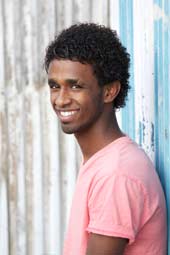 |
| Ashgaram's succes makes him a model for his Ethiopian-Israeli peers. Photo: JDC Website |
Ashgaram harnessed this encouragement, coupled with his mother’s unwavering support, and by example became someone whom his teachers and mentors call “an adored leader among his peers and a positive influence on the less motivated students in the program.”
Today, Ashgaram’s story speaks for many, reflecting the program’s overall achievement in helping more than 3,000 vulnerable youth reach their potential and have access to a brighter future. Now some 62 percent of the city’s eligible Ethiopian-Israeli high school students receive their matriculation; this compares to a national Ethiopian-Israeli average of 40 percent and a citywide Rehovot result of 58 percent.
For its success both in numbers and in engaging the local community members, Birth-to-Bagrut was recently highlighted in the city of Rehovot’s 120th anniversary celebration as a model for bolstering immigrant absorption and integration in the city.
December 14, 2010
JDC: A Gateway to Freedom - New Photo Slideshow
Throughout the history of JDC, we have helped take care of and sustain Jews fleeing persecution and danger, Jews caught in transit, unable to proceed directly to their ultimate destinations of emigration. Soviet Jewish émigrés were the most well known of these transmigrants.
Check out the new slideshow of archival photos highlighting JDC's work in caring for these émigrés in transit at JDC: A Gateway to Freedom.
 |
| Photo: JDC Archives |
Check out the new slideshow of archival photos highlighting JDC's work in caring for these émigrés in transit at JDC: A Gateway to Freedom.
December 9, 2010
JDC's Work in Haiti Featured on CBS Special Broadcast
A recent national CBS broadcast on the work that religious groups are doing in Haiti features the work of JDC, including interviews with CEO Steven Schwager and JDC Haiti Representative Gideon Herscher. The reports focuses on JDC's newly dedicated rehabilitation clinic and prosthetic workshop developed together with Israel's Magen David Adom and Sheba Medical Center at Tel Hashomer Hospital as well as the Haitian Red Cross and the HUEH (l'Hôpital de l'Université d'Etat d'Haïti). The modernized facilities are the first of their kind in Haiti.
JDC's non-sectarian disaster relief programs are funded by special appeals of the Jewish Federations of North America and tens of thousands of individual donors to JDC.
You can also watch the video at this link: http://www.youtube.com/watch?v=lTHyWvRJWP8&feature=sub
December 8, 2010
Helping the Neediest Jews Brave Harsh Winter
 |
| Photo: JDC Website |
Since their utilities were cut off long ago, the family has been using their furniture as kindling to build fires each winter to warm their home. Through the International Fellowship of Christians and Jews (IFCJ)/JDC Partnership for Children in the Former Soviet Union (FSU), they are now getting support for winter heating and clothing. The parents receive food cards for their children, and the Partnership has provided the family a hot plate for cooking.
 |
| Two of the Mardakhayev boys show their makeshift sleeping arrangements Photo: JDC Website |
In an equally run-down Baku neighborhood, 72-year-old Gyavar Aliyev shares her tiny apartment with her son and two teenage grandchildren. Gyavar is slowly losing her sight—and her home has no running water, so she must use an outhouse and the well located in the rat-infested courtyard that she shares with three neighbors.
For these poorest of Jewish children, families, and elderly in the former Soviet Union, JDC assistance mitigates suffering and helps them survive the harsh winter season with dignity.
December 6, 2010
JDC Accepts Donations To Aid Israeli Fire Evacuees

 |
| CLICK ABOVE |
"Our hearts go out to Israel and especially to those mourning the loss of their loved ones to these destructive fires. JDC's Emergency Response Team in Northern Israel was activated immediately and reached out to the elderly, disabled and youth-at-risk to help ensure their swift evacuation and provide basic needs and emotional support to them during this traumatic time," said JDC CEO Steven Schwager.
In addition, JDC’s network of Israeli volunteer initiatives is working closely with local municipalities to provide additional support in the area. JDC's Emergency Response System -- developed during the second intifada and the Second Lebanon War -- is ensuring support and assistance is delivered.
In the aftermath of the fires, JDC will launch immediate rehabilitation programs that will provide assistance to affected vulnerable populations. Additionally, JDC will assist with the ongoing deployment of local emergency response teams and psycho-social support for children and families.
JDC is working closely with the Israel’s Ministries of Social Affairs and Health, Home Front Command and the National Emergency Network to monitor the situation and make a clear assessment of current and future needs once the fires have been extinguished.
To Make a Contribution:
Online: http://www.jdc.org/
By Phone: 212-687-6200
By Mail: check payable to
JDC-Israel Fire Relief
P.O. Box 530
132 East 43rd St
New York, NY, 10017
December 5, 2010
Reflections from JDC Youth Volunteer Coordinator in the Fire Zone
Tomer Ilan, age 24, is the coordinator of JDC’s AMEN youth volunteer program in his hometown of Haifa, where he also volunteers with Fire Fighters in Israel. Through AMEN, some 60,000 youth in dozens of cities throughout Israel give more than 4 million hours a year of volunteer service to their communities.
Tomer describes the past 24 hours:
On Thursday at around 12:30pm, I heard about the fire outbreak. I left my office, contacted Fire Fighters in Israel, and ran to the fire zone to the Beit Oren junction near Druze Village of Osafiya. AMEN is a partner of Fire Fighters in Israel in the local area to train local youth in first aid. Tragically, one 17-year-old volunteer wanted to help so badly that he went on his own initiative and was consumed by flames...
At 9pm, I was released from first-aid role and began coordinating JDC AMEN youth volunteers in Haifa. Many of our volunteers called wanting to help in any way possible, but there was no role for them at that moment in the midst of the firefighting efforts.
The area filled with such a blanket of thick black smoke that the shift from afternoon to evening to night was not even noticeable. People described the heavy smoke as if it were a ‘nuclear mushroom cloud.’ The harsh smells of burning forest are mixed with the white smoke arising from where the firefighters are working and dousing the flames.
The tense situation brought me back to the days of the Second Lebanon War in 2006 when there were no cars on the streets and people were stuck in their homes. There is total silence in the area. But my sense is that there was no mass panic. There is a sense that things are under control, that the fire fighters are working strategically and in a coordinated fashion to battle the blaze.
There is much concern about the fire that broke out in several places in other heavily populated areas around Haifa – Nesher, Neve Yosef, etc. – I can see some of these flames from my own porch.
My concern is that people have not yet begun to understand the magnitude of what has happened.
December 3, 2010
JDC REPSONDS TO THE DEVASTATING FIRES IN THE NORTH OF ISRAEL.
For information about how you can help, please visit the JDC Website.
In response to the devastating Carmel fires, JDC immediately activated its Emergency Response Team in the North and continues to coordinate relief and recovery efforts with local authorities and the Israeli government to ensure the safety and well-being of the most vulnerable in the area, especially evacuated elderly, disabled, and youth at risk.
Also, JDC’s network of Israeli volunteer initiatives is working closely with local municipalities to provide additional assistance. In communities where these volunteer programs exist, the ability to quickly address the needs of evacuees was marked in comparison to other locations. JDC’s Emergency Response System—developed during the second intifada and the Second Lebanon War—is ensuring the swift delivery of all needed support.
We are working closely with the Israel’s Ministries of Social Affairs and Health, Home Front Command and the National Emergency Network to monitor the situation and make a clear assessment of current needs and those that will arise once the fire has been extinguished.
In response to the devastating Carmel fires, JDC immediately activated its Emergency Response Team in the North and continues to coordinate relief and recovery efforts with local authorities and the Israeli government to ensure the safety and well-being of the most vulnerable in the area, especially evacuated elderly, disabled, and youth at risk.
Also, JDC’s network of Israeli volunteer initiatives is working closely with local municipalities to provide additional assistance. In communities where these volunteer programs exist, the ability to quickly address the needs of evacuees was marked in comparison to other locations. JDC’s Emergency Response System—developed during the second intifada and the Second Lebanon War—is ensuring the swift delivery of all needed support.
We are working closely with the Israel’s Ministries of Social Affairs and Health, Home Front Command and the National Emergency Network to monitor the situation and make a clear assessment of current needs and those that will arise once the fire has been extinguished.
December 2, 2010
In Time for Chanukah, Sofia Dedicates First Jewish Preschool in More Than 50 Years
 |
| Benvenita enjoys a Kosher breakfast at her new preschool. Photo: JDC Website |
Located in the local Beit Shalom Jewish Community Center and across from a synagogue, the nursery is quickly becoming a haven for Benvenita and more than 20 other children, ages 2-5 years. There they learn basic Hebrew, Jewish traditions, and enjoy Jewish-themed toys and educational tools in a well-equipped, modern facility that includes a spacious area for dancing and role-playing, multimedia equipment, and a piano. The school also provides daily kosher, nutritious meals—two breakfasts and a three-course lunch—which is a compelling benefit rarely offered by the state institutions.
“I haven’t seen a better designed and organized place for children in Sofia,” said Shlomo.
In fact, this newly dedicated preschool helps address an important need in Bulgaria at large, where a shortage of state-run preschools has left some 3,000 children without an early-education framework. Gan Balagan charges the lowest tuition among all of the private preschools and is seeking subsidies for families that cannot afford to cover the full cost on their own.
 |
| Photo: JDC website |
Shlomo didn’t begin to explore Judaism with fervor until the mid-1990s, when he was 18; today he and his wife, Iliana, open their home to more than 20 people for Shabbat, and own the first kosher café in Sofia where they produce kosher challot.
“It makes me feel calm that my child will grow up with a strong Jewish identity and with an excellent premise for her future Jewish education,” said Shlomo, referencing the transition Benvenita could make from this preschool into the community’s Jewish primary and high schools. “Our son was just born last month, but we are very happy that a couple of years from now he will join this Paradise for Jewish kids."
December 1, 2010


Subscribe to:
Posts (Atom)