October 22, 2013

JDC Supporters Join Together To Create Impact Network

Several years ago, Jon Deaner traveled to Argentina on a UJA-Federation of New York-led mission with other young professionals to learn about Jewish life and tradition. Among the most moving experiences he had was his visit to a JDC day care program called Baby Help where he met young children living in poverty.

Jon Deaner poses for a photo with children in Argentina.
A photographer, Jon captured his visit in beautiful pictures. But as his initial connections to the children faded with the passage of time, it was that tangible feeling of being involved and making a difference Jon sought to replicate in a brand-new initiative at JDC. 

At about the same time, Doron Goldstein -- the son of JDC Board Member Yoine Goldstein and one of the founders of Entwine, JDC’s young Jewish leadership platform -- was looking to transition from Entwine but remain actively involved with JDC.

Doron grew up traveling all over the world, meeting Jewish leaders from different communities and witnessing firsthand the lifesaving work of JDC.  He understood the only way to be an instrumental player in JDC’s work was to engage head-on with program directors and content. 

Together, Jon and Doron founded the first donor group under JDC Ambassadors. At a membership level of $2,500, the Impact Network model provides access to JDC Ambassadors events and engagement. Group members focus on a particular issue under JDC’s purview and then commit to raising funds for a project they believe in.

All of this comes as no surprise in 2013. Jewish philanthropy research shows new donors are excited to be involved in charitable causes. Many serve on non-profit boards, encourage friends to give and donate online; and once they are hooked, they want to go “all in.” 

“They want to develop close relationships with the organizations or causes they support; they want to listen and offer their own professional or personal talents, all in order to solve problems together with those whom they support,” the research sats. Jon and Doron’s desire to “be information-driven, impact-focused, proactive, and peer-oriented” spoke to all members of the Child Intervention Impact Network.
Under Jon and Doron’s leadership, the group chose to learn about JDC’s involvement in early childhood programming and voted to support JDC’s Baby Help in Argentina. They met over Argentine wine and discussed Argentine history and politics; they learned about Baby Help from the director, Viviana Bendersky; they asked early childhood experts based in New York about the most up-to-date practices. They plan to support Baby Help concretely by purchasing vaccines and meals, raising awareness and communicating new trends in care. The bottom line: They are strategic philanthropists.

Following this idea, other groups have formed using the Impact Network model focusing in an issue of their choice. JDC is looking forward to engaging individuals more directly and giving donors the opportunity to be hands-on involved. To learn more about or join JDC Impact Networks, visit: http://www.jdc.org/impact. 

This blog post features information from pages 11-16 from the report Next Gen Donors: The Future of Jewish Giving.

May 9, 2013

Making the Connection: JDC's Ambassadors Symposium

Making the Connection was the theme of the JDC Ambassadors Symposium, May 6-7, focusing on how we can make a genuine and meaningful connection between us as caregivers and philanthropists and the people in need around the world that we help. 

The ideal connection would look very different from the top-down approach that too often has served to increase the divide among people. It would be about achieving true empathy, about empowering the people we help so that they are the best allies in helping themselves, and about stretching how we do philanthropy and engage others.

Monday's session looked at how we care for our friends as a model for how we do good in the world.

Park Avenue Synagogue’s Rabbi Cosgrove spoke about empathy and the Hebrew concept of arevut, the responsibility we have towards one another (click here). Letty Cottin Pogrebin spoke about her personal experience fighting breast cancer and the type of care that she sought from friends and family, and articulated principles that resonated with her experience and others' with whom she spoke. Foremost among them was the importance of listening to the voices and wishes of the people we want to help and not assuming that we know best.         

What might this principle look like if we put it into play in our humanitarian work as well as our personal lives?

There are few programs that better demonstrate JDC's vision of listening to and empowering the people we serve than Jay Ruderman’s groundbreaking work with disabled people in Israel -- a partnership among his family foundation, JDC and the Government of Israel that goes by the name Israel Unlimited.  A staggering 1 million people suffer from disabilities in Israel (key stats here), but the program does not focus on accessibility alone. Instead, it makes disabled people the actors in their own story -- helping them to challenge stigmatization (here's an excellent piece on an inspiring blind Arab Israeli woman) and build up their confidence and abilities to act as positive forces in their communities through volunteerism and a new emphasis on work.
 

April 22, 2013

Poland: 70 Years Later

by Rebecca Neuwirth

In the end, it’s Agatha who makes it impossible not to hope.

I’m with a JDC Ambassadors delegation at the 70th anniversary commemoration of the Warsaw Ghetto Uprising. At midnight on April 19, in the light of two flames that rise from menorahs on either side of the famed Ghetto monument, Cantor Yaakov Lemmer sings in Yiddish about small boys who steal outside to sell cigarettes, and of a searing loss of innocence. Next to me, a member of our delegation sings quietly along—she remembers the tune from childhood.
A memorial for children at the 
Jewish cemetery in Warsaw.
Children's Memorial in Warsaw Jewish Cemetary

Loss of innocence is an elegant metaphor for the brutal desperation that drove parents to allow their young boys to risk their lives to bring home crumbs. The story of the Warsaw Ghetto is unendingly heinous. At its height, over 400,000 Jews were imprisioned in 1.3 square miles. Starvation and violence killed some 100,000 in the first year, and the Nazis deported almost 300,000 to mass murder in Treblinka. Cruel selections separated mothers and fathers from their children; sadistic and senseless acts were the rule, with human kindness used as a lure for brutality.

But the commemoration of the Warsaw Ghetto Uprising, unlike other forms of Holocaust remembrance, focuses not on atrocities but on courage.

It draws attention to acts of resistance and stubborn humanity, from the courage of small boys to the sharing of crumbs of food, the caring for orphaned children – embodied by the amazing Janusz Korczak, even the creation of culture that persisted in the Ghetto in the face of inhuman conditions. Above all, it focuses on the final armed resistance waged by a few thousand Jews against the impossibly larger, full force of the Nazis, and that ended one month later in total destruction and with only 13 Jews remaining.

February 19, 2013

Jewish Renewal in Kazakhstan

Hesed Center with young Kazakh Jews.
by Dov Ben-Shimon

"Yulia" -- dressed in orange
I've just spent the last week in Turkey and Kazakhstan on a JDC Strategic Partnerships/Ambassadors Circle mission and wanted to share something that made a deep impression on me.

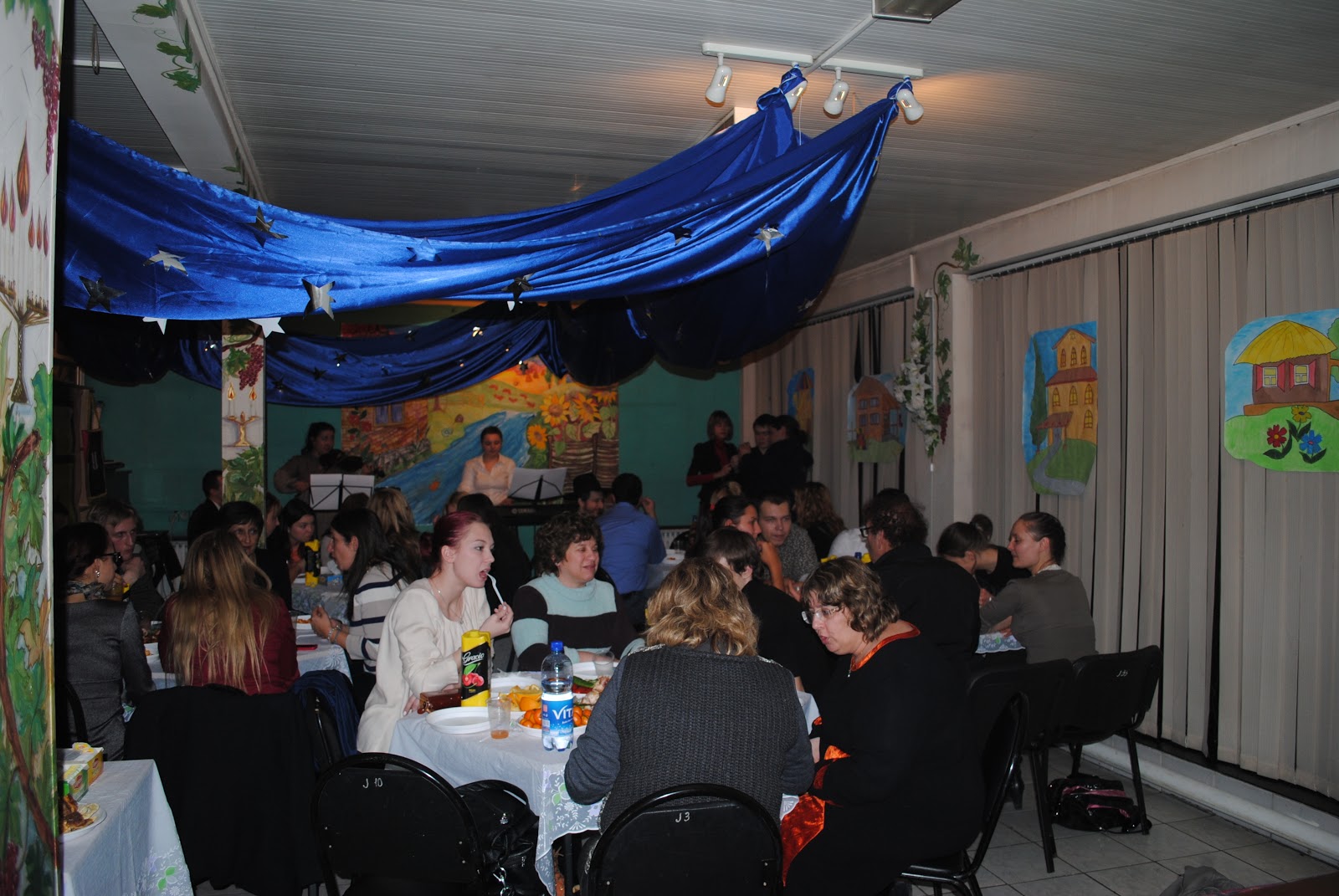
At dinner the other night in Almaty, Kazakhstan, I sat with two young leaders of the Jewish community. Michael  and his wife Yelena are very involved with the Almaty community. He is a building contractor and she is a graphic designer. They're both in their early forties and they both volunteer in the Hesed, our federation-supported welfare center. In Almaty the Hesed also functions as a JCC, and they sit on the Board.

Here's the story: Michael grew up knowing he was Jewish. It wasn't a particularly significant part of his life. His mother actually listed their nationality as "Ukrainian" rather than "Jewish" on their internal Soviet passports. She had lived through nasty anti-Semitic attacks in Ukraine before the family moved to Kazakhstan, which has a low level of anti-Semitism. When Michael and Yelena married, religion wasn't really an important topic for either of them, and in a country in which there are high levels of intermarriage, he thought nothing of marrying a nice non-Jewish girl like Yelena.

December 4, 2012

What is our Global Jewish Responsibility?


Peter J. RubinsteinRemarks by Rabbi Peter J. Rubinstein, Senior Rabbi, Central Synagogue
Delivered at the JDC Ambassadors Global Symposium
December 3, 2012

It is a tremendous honor to be with you this morning and a special joy to personally salute you who are involved in and support the JDC.  In my mind you are responsible for and further the work of one of the great heroic organizations of Jewish life. To say this is not hyperbole because I have seen your work in action around much of this world.

Perhaps the most personally stunning and surprising experience I had with JDC was when in the late 1990’s I travelled with a small group of Jewish leaders to visit an Albanian refugee camp during the height of the Kosovo conflict and then to take some of those refugees with us to Israel. In those days brutalized refugees were flowing across the border seeking food and water and shelter and refuge.

I’m not sure what I expected when I arrived in Albania but a tent with a JDC sign outside was nowhere on my screen of possibilities. It was there and then that I came to understand the expansive theater of JDC operations which combat the results of human warfare and misery and are on the ground in the face of the most horrendous natural disasters as in Haiti after the earthquake. I comprehend the exquisite purity of an organization which has as its focus saving people in extremis no matter what their national origin, race, religion or gender. For that I salute and thank you.

The topic you have asked me to address is “What is our Global Jewish Responsibility?” In forming this question I suspect the planners of this symposium were purposeful in framing the question with inherent ambiguity for in fact this topic properly raises two very separate issues.

October 22, 2012

JDC Ambassadors Global Symposium, December 3

The Jewish Future:
New Strategies for Sustaining and Inspiring Jewish Life

New York City

Guest Speakers:
Peter J. Rubinstein, Senior Rabbi of New York's Central Synagogue
Anne Heyman, Founder & Board Chair - Agahozo-Shalom Youth Village
Jack Habib, Director, Myers-JDC-Brookdale Institute
and more...

FOR MORE INFORMATION -- go to http://jdc.org/ambassadorssymposium

JDC has worked for almost 100 years in supporting Jewish life around the world. But even as we help individuals and communities deal with crisis and handle extreme poverty on a day-to-day basis, our middle and long-term aims are more elevated and strategic: to ensure robust and inspired Jewish communities that care for one another.

The December 3 Ambassadors Symposium examines the Jewish future. How can we support small, vulnerable Jewish minorities in Muslim countries against the backdrop of the Arab spring and heightened global tensions? And, how can we share successful local Jewish and Israeli program models of care with other communities and the larger world – as a way to build bridges, scale impact, and fulfill our mandate of tikkun olam, or healing the world.

Peter J. Rubinstein, Senior Rabbi of New York's Central Synagogue, will offer a keynote address on what global responsibility really means today.

The Symposium will also introduce a new feature: JDC Think Tank sessions, which will allow key leadership to “roll up their sleeves” with participants to address current open questions on the spectrum of JDC’s work. Roundtable discussions will range from maximizing renewal activities in the increasingly trendy city of St. Petersburg, Russia to inspiring young American Jews to embrace a global and Jewish tikkun olam agenda, and more.

___

JDC Ambassadors Symposia provide in-depth opportunities to understand how the latest global events are impacting Jewish communities around the world – and what we can do about it. Symposia are open to JDC Ambassadors, members of our Ambassador Circle and Society, and select guests.

October 15, 2012

Argentina Expedition, RESCHEDULED for 2013

JDC Ambassadors Argentina Expedition
NOW RESCHEDULED -- March 10-13, 2013


Home to Latin America’s largest Jewish population, Argentina has been a prosperous country for much of its history. The country and its Jewish community were catapulted into economic turmoil during the 2001 economic crisis and resulting devaluation of the Argentine peso. Middle class families in particular bore the brunt of the collapse, and many Jewish families found themselves turned into “the new poor” virtually overnight.

This visit will offer an unprecedented opportunity to meet an important Jewish community in recovery. JDC’s work has focused on helping the most vulnerable Jews in Argentina and supporting the community’s ability to rebuild itself in a sustainable way. Throughout the trip, we’ll meet the wonderful people who are working with JDC to help children and elderly and to ensure the vibrancy of Jewish life and community.

We’ll also see the sites of Argentina, enjoy an evening of tango, and get the inside story of a world-class city that has undergone more than its share of instability in recent decades.

For more information and costs, contact Rebecca at rebeccan@jdcny.org or (212) 885-0878

JDC Ambassadors travel opportunities allow you to see the inside story of how Jews and others live in key cities around the world. Travel is open to JDC Ambassadors, members of our Ambassador Circle and Society, and select guests.

October 10, 2012

JDC Ambassadors New York Program, October 22

Can we turn the tables on poverty? Real lessons from the field in Israel, Russia, Haiti and beyond
JDC Ambassadors Meeting
Monday, October 22, 5 pm doors open, 5:30-7 pm program
New York

An article about this event is now available on the JDC Field Blog.

JDC's experience in combating poverty around the world contains not only a treasure trove of stories of individual dedication and initiative in the face of adversity, but also a myriad of valuable lessons learned about how best to address and ultimately end poverty.
The largest Jewish humanitarian organization, JDC leverages nearly a century’s experience to create effective programs that benefit some of the world’s neediest populations faced with disaster, extreme poverty, political instability, and genocide. JDC’s lifesaving interventions in the World War I and World War II eras are legendary; its work today helps hundreds of thousands of people in crisis and focuses on sustainable solutions to Jewish poverty and beyond.
Featuring from the field:
  • Galit Sagie on the keys to social mobility in Israel
  • Rina Edelstein on addressing overwhelming need among elderly Jews in the former Soviet Union
  • Mandie Winston on the importance of empowering people to help themselves
  • Moderated by Gideon Herscher, program development expert
For more information, contact Rebecca Neuwirth, rebeccan@jdcny.org
___
JDC Ambassadors programs provide insight into the state of Jewish communities around the world – and what we can do about it. Programs are open to JDC Ambassadors, members of our Ambassador Circle and Society, and select guests.

September 6, 2012

Bringing a Sweet New Year to Families in the Crimea

With their local Hesed now a second home,
Vika, her sister, and her mom know they won’t
be alone this Rosh Hashanah.
Photo:  JDC Website

Six-year-old Vika, her sister Vera, 11, and her mom, Olga celebrated their very first Rosh Hashanah last year.

Since then, they’ve come to call the Jewish community in Feodosiya, their native town in the Crimea, a second home. For this single-parent family, Jewish life has become a much-needed anchor in their otherwise tumultuous existence. This year they couldn’t be more excited to visit their localHesed social welfare center for communal festivities and honey cake.

Olga grew up under communism, when religious practices were outlawed and Jewish life was hushed for decades. She never learned any Jewish history or traditions in her home as a child; when she became a mom, she had none to pass on to her daughters.

August 24, 2012

JDC Event to Feature Professor Dan Ben-David on Israel's Internal Challenges


Professor Dan Ben-David
Professor Dan Ben-David, along with JDC Israel Regional Specialist Kobi Tav, will give a talk on September 13th at 5pm called “The Start Up Nation’s Threat From Within; Finding Solutions.”

“The academic achievements of Israeli students are incredibly low compared to other westernized countries.” This startling statement from the Taub Center for Social Policy Studies should give one cause for worry. Its effects could mean a disastrous future for Israel if they are not reversed soon.

This troubling fact is one of the reasons why Professor Dan Ben-David devotes so much time to researching ways to improve the economy in Israel. The Executive Director of the Taub Center, Professor Ben-David, is one of the foremost economic voices in Israel in the push for a greater and less stratified Israeli economy. At an upcoming event that will take place at JDC Headquarters, Professor Dan Ben-David will detail the socio-economic changes that pose a challenge for the long-term health of the Israeli economy.

More and more people are immigrating to Israel, many of them from different ethnic groups. However, in contrast to the rising population rates employment rates have been decreasing. New immigrants are not contributing to the growth of Israel’s economy.

Professor Dan-Ben-David argues that by putting strength into the education system, more people will become part of the Israeli economy. “Education is the basic national infrastructure. It is a primary factor in providing equal opportunities for full realization of individual abilities.”

Ben-David, one of Israel’s leading economists, has discovered a multitude of alarming facts concerning the state of Israeli education. Education gaps in Israel are among the highest in the West. Few students take core classes and the class sizes are inconceivably large. The education gaps between students also rate as some of the most unequal in the west. “The failure is systemic; continuing in this way is no longer an option,” he wrote in a recent study.

Professor Ben-David, as the Executive Director of the Taub Center, works closely with JDC’s Israel program office to address the issues that are holding back Israel’s potential and threatening its future success. “The ability of the Joint [JDC] to join forces with the government in innovating social services, in doing pilot projects that are studied as they go ahead in order to measure the potential national impact that they can have…this is having a long-term impact on Israeli society,” said Professor Manuel Trajtenberg.

JDC founded the Taub Center in 1982 and still remains a fundamental supporter of the institution. RSVP is mandatory to this event. For more information email Rebecca Neuwirth at rebeccan@jdcny.org or call 212-885-0878.

August 20, 2012

JDC Ambassadors Missions
Sarajevo September 28-30, 2012
Extension to the Croatian coast October 1-3, 2012
From top to bottom: Latin Bridge, a
historic Ottoman bridge over the River Miljacka; participants in the Race for the Cure® organized by JDC's Women's Health Empowerment Program (WHEP) and Susan G. Komen for the Cure®; the Sarajevo Synagogue on the south
bank of the river Miljacka, Bosnia and Herzegovina.
Mission Highlights

Join families of diverse faith and ethnicities in Sarajevo in a 5-mile run/walk to fight breast cancer

Meet the Jewish leader who pioneered JDC's Women's Health Empowerment Program in the Balkans and the unsung heroes who have expanded it across the region

Be embraced by the hospitality of the Jewish communities in Sarajevo and the picturesque cities of Mostar and Dubrovnik
.................................................................................
Visit Sarajevo and the Croatian coast

Open to JDC Ambassadors and their Families

As we commemorate the 20th anniversary of the siege of Sarajevo, which
marked the start of the Bosnian war, we will join together in an act of strength and hope: a walk to promote breast cancer awareness and treatment. We will also meet the city's resilient Jewish community, which took the lead in protecting its members and helping others during the Balkans' drawn-out conflict.

We will explore Sarajevo's centuries-old Jewish heritage, including visits to the Jewish synagogue, the Jewish cemetery, and a viewing of the world famous Sarajevo Haggadah.

This once-in-a-lifetime opportunity includes a chance to see Croatia's
breathtaking coast and meet its small, embracing Jewish communities.

.................................................................
For more information, please contact:

Contact: Rebecca Neuwirth 212-885-0878 or rebeccan@jdcny.org

Participation in the mission requires a minimum gift to the 2012 JDC
Ambassadors Campaign to help Jewish Rescue, Relief, and Renewal programs around the world.

JDC Ambassadors. Philanthropy that Changes Lives.

The American Jewish Joint Distribution Committee (JDC) is the world's leading Jewish humanitarian assistance organization. JDC works in more than 70 countries and in Israel to alleviate hunger and hardship, rescue Jews in danger, create lasting connections to Jewish life, and provide immediate relief and long-term development support for victims of natural and man-made disasters. To learn more, visit www.JDC.org.

Campers with Disabilities Rejoice at Szarvas

“I return to Szarvas every year to see my
friends and feel something I cannot feel
anywhere else—happy,” says Henrik Z., 32,
who has Down’s syndrome.
Sourse: JDC Website

All year long Henrik Z., 32, who has Down’s syndrome and lives with his pensioner mother inBudapestHungary, looks forward to the most special week of his summer. That’s when he goes to camp Szarvas, where he sees his friends, plays soccer, and celebrates Shabbat with the community he feels closest to.

“I return to Szarvas every year to see my friends and feel something I cannot feel anywhere else—happy,” he says.

Home taught by his father for much of his life, Henrik started to attend a special school for the first time when his dad died about 10 years ago. As he began to socialize with his peers, his teacher recommended that he attend a summer program to maintain his social development and interaction throughout the year. That’s when he learned about the one-week summer program for people with disabilities at the Ronald S. Lauder Foundation/JDC International Summer Camp in SzarvasHungary.

August 13, 2012

Helping in Haiti

Photo credit: Hollis Rafkin-Sax
by Jayne Lipman
co-chair, JDC Ambassadors
member, JDC Board of Governors


There is something addictive about helping in Haiti.

During my recent trip with JDC Interface, I met volunteers from all over the world who told me that they came to help in Haiti and never left, or that they couldn't wait to come back again.

It's a strange thing to say in a country that has been so devastated - not only by the 7.0 earthquake, which occurred on January 12, 2010 and immediately hit the front pages, but also by decades of corruption, questionable foreign interventions, revolutions and coup d'états that have eroded the once beautiful countryside and stolen the hope of so many of its people.

But that's precisely how outsiders fit in. Relief organizations bring equipment and know-how, but also a stubborn imported optimism.

August 1, 2012

Mostar on the Map

The Stari - Most Bridge in historic Mostar. Photo: Ramirez HUN
As part of the JDC Ambassadors Expedition to Sarajevo and the Croatian Coast, which takes place on September 28-30 and October 1-3, there will be a visit to the gorgeous city of Mostar. A city rich with 
history and a story behind every step, Mostar is one of Bosnia and Herzegovina’s most mesmerizing cities.

Mostar’s roots stem all the way back to the 15th century as part of the passage between the Adriatic Sea and important parts of Bosnia. As Jewish refugees escaped to Mostar during the Spanish Inquisition, a small Jewish community grew over time into a thriving one, with many members finding successful livelihoods as doctors and merchants. A small hamlet of Jews continuously existed in Mostar, numbering up to 100 people at the dawn of WWII. A synagogue was built in 1902, serving the city’s Jewish population until anti-Semitism erupted in 1942. Only two years later Nazi and Ustasha soldiers burnt the Mostar synagogue to the ground.

Sadly, only a few Jews returned to Mostar after the war; most of them either survivors of the Holocaust or escapees from other parts of Eastern Europe. Although they had found their homes ravaged by tragedy and destruction, they stayed and worked hard at re-building their once-thriving Jewish community.

July 24, 2012

Sights From Dubrovnik


The main street of Dubrovnik's Old Town. Photo: Laszlo Szalai
From September 28-30 to October 1-3 JDC Ambassadors will be leading an expedition to Sarajevo, Dubrovnik, and the Croatian Coast. This mission will combine historic insight, social advocacy, and an exploration into the fascinating Jewish life of Croatia and Bosnia and Herzegovina.

With a breathtaking view of the Adriatic coastline, spectacular medieval walkways, and culture and history at every turn, the city of Dubrovnik is not to be missed. Beneath its picturesque exterior however, lies a city that was once home to a reserved but robust Jewish community. Dating back to the 14th century, the Jewish community of Dubrovnik is a resilient one, hosting a synagogue, museum, and multiple treasured artifacts.       

One of the most famous sights in all of Dubrovnik, and not just in the Jewish world, is the Dubrovnik Synagogue. Built in the 14th century, it is the second oldest synagogue in the world in addition to being the oldest Sephardic synagogue. It houses torah scrolls dating back to the 13th or 14th century that contain some of the oldest styles of Hebrew script. They demonstrate a variety of calligraphy that is noticeably different from the writing style seen in most torahs. These scrolls are now housed in the synagogue’s museum and have been viewed as far away as New York City.

July 12, 2012

Camping in Belarus Brings Families to Jewish Community


This summer Pavel will be among thousands 
of Jews participating in JDC-supported day 
camps, family retreats, and intergenerational 
Shabbatons taking place throughout the 
former Soviet Union.
Mirroring a common reaction among fellow Jewish 10-year-olds in Minsk, Belarus, Pavel’s eyes light up with excitement at the mere mention of “Shemesh” Camp at his local Jewish Community Center (JCC). That’s because Pavel can’t wait to join his friends for a 10-day session of fun and Jewish learning that will include trips to parks, museums, movies, and other attractions around Minsk.

With hundreds of kids and families attending the Minsk JCC annual summer program, Jewish camping has become the new “in vogue” thing to do in the Belarusian capital.

For the past 20 years, JDC has exponentially expanded opportunities for Jews in Belarus and across the former Soviet Union (FSU) to connect with their local communities. In the process, Jewish camping has become a premier outreach activity, bringing together kids and families eager to take a holiday with rich Jewish content and offering a gateway into Jewish life year-round at Minsk’s JCC Emunah.

July 9, 2012

JDC Helps Russian Jews Affected by Floods

In response to Saturday's flash floods in Russia's Krasnodar region -- which left more than 150 people dead -- JDC activated its emergency network and staff in the region immediately began reaching out to the local Jewish population and assessing damage. Though there were no reported Jewish victims among the dead, a handful of elderly, including Holocaust survivors, reported extensive, and in some cases irreparable damage, to their homes.

Rescue teams from Russia's Ministry of Emergency Situations evacuated many people from their homes. In the meantime, JDC's Hesed staff have been in continuous touch with clients in the hardest hit towns of Krimsk, Gelendzhik and Novorossiysk to ensure they are safe and JDC will be aiding in repair and rebuilding costs for homes as damage assessment is completed. There are more than 500 Jews in the affected areas.

Here is some of the latest coverage: http://www.bbc.co.uk/news/world-europe-18765305

June 27, 2012

JDC Ambassadors Plan Fall Expedition to Sarajevo and the Croatian Coast

The remains of the Stari -Most Bridge in Mostar, Bosnia and Herzegovina. Over 400 years old, the landmark bridge was destroyed during the Bosnian War in 1993, as was much of the tranquil scenery that surrounded it. JDC Ambassadors will travel to the region, which has been rebuilt to its original beauty.
Photo: Edward Serotta
The next mission with JDC Ambassadors will be to the majestic cities of Sarajevo and Dubrovnik from September 28-30 and October 1-3. Come meet the brave women who have battled breast cancer and the harsh societal stigma that is still associated with it. Explore the small but resilient Jewish communities that call Sarajevo and Dubrovnik their home.

The highlights of this mission will include an optional 5k run/walk to fight breast cancer and a chance to meet the Jewish leader who laid the groundwork for the JDC Women's Health Empowerment Program in the Balkans, as well as the people who have helped to enlarge across all ethnic and religious communities in the area.

We'll also visit Sarajevo's famous Jewish Cemetery, view the world famous Sarajevo Haggadah, travel along the gorgeous pathways that are home to the Latin and Stori-Most bridges among many other incredible landmarks and views along the breathtaking Croatian Coast. 

Sarajevo is marking the 20th anniversary of the start of the infamous siege, which signaled the start of ethnic bloodshed and led to the Yugoslav wars, the bloodiest in Europe since World War II. Its Jewish community is small in numbers but not in spirit. Through the support of JDC the community took on an important role in providing a safe haven and essential supplies during the siege, and rescuing community members and others when the situation became unlivable. 

For more information please contact Rachel Rosenthal at rachelr@jdcny.org.

June 25, 2012

JDC Israel Focuses on Empowerment

By Rebecca Neuwirth, Director, JDC Ambassadors

A huge moon is hanging over my shoulder in Tel Aviv, a city I haven't been to since I became a mother over seven years ago and put a brake on long travel.

A lot has changed in that time, but not the tender breeze, the slightly sweet smell of blossoming summer in a dusty city. The smell of cats too - in every small street I sense them - on steps and mailboxes and sliding between parked cars. The simple cafes, the handsome people, the certain knowledge that the ocean is just hidden beyond these small streets, win me over again.

I'm here with 70 people for the JDC Board mission. We are visiting projects that address serious social issues in Israel. I'm excited to see that JDC is hitting all the right notes.

June 12, 2012

Letter to friends: visiting Israel with JDC


Judah Kraushaar, member of the JDC Ambassadors Steering Committee, joined JDC's Board for a mission in Israel in early June 2012. Below are reflections that he shared with a group of his friends about the work and impact of JDC in Israel.

Friends,
I recently had the good fortune to travel with the board of The American Jewish Joint Distribution Committee (JDC) examining in depth its work in Israel. As you may know, the JDC has become one of my passions, and I hope you’ll allow me to share a small part of what I saw and learned from this incredibly stimulating experience. I’ve been to Israel many times typically as a tourist or in the context of my interest in political advocacy; but this trip allowed me to see a very different side of the country—it focused on the challenges posed by the soft underbelly of society, a world where the poor, disenfranchised, and even migrant populations struggle daily. In many countries, such a focus would have been totally depressing; but, as you might have guessed, the commitment in Israeli society to address social problems, combined with Israeli innovation and passion—and helped along by the JDC’s work—made this visit to Israel one of my most uplifting ever.