JDC Ambassadors will be holding an important lunch marking 20 years since the start of the siege of Sarajevo, which ironically is April 6, the start of Passover this year.
The discussion centers around an extraordinary Jewish response to the breakdown of ethnic trust and cooperation in this diverse city.
But there are also clear lessons to be learned today, when ethnic strife in Bosnia, the Middle East and virtually across the globe seems to be heating up, not cooling down. We'll feature some very unique and meaningful efforts that the Jewish community has undertaken to lead in the rebuilding of trust and the solving of shared challenges across the globe.
And stay tuned for information about the Ambassadors trip to Sarajevo to participate in this work of rebuilding.
More info? Contact Rebecca At rebeccan@jdcny.org
Two decades from war, a new fight to save Bosnia
Showing posts with label JDC Archives. Show all posts
Showing posts with label JDC Archives. Show all posts
April 4, 2012


March 5, 2012
JDC Global Archives Website Brings Jewish History to Life

Also, check out the post about the launch at eJewish Philanthropy.
Which U.S. president publicly urged Americans to support the first campaign aiding war-ravaged Jews overseas? Which organization brought the first John Deere tractor to Ukraine? What killer disease was eradicated in Ottoman Palestine by a Jewish doctor?
May 3, 2011
JDC RELEASES OVER 500,000 SEARCHABLE HOLOCAUST-ERA NAMES AND HISTORIC PHOTO COLLECTIONS
Visit the Website - http://www.jdc.org/sharedlegacy
New York, May 2, 2011 ― For the first time in its history, the American Jewish Joint Distribution Committee (JDC) is making a collection of its historic records and photographs from the Holocaust period available online. The website – www.jdc.org/sharedlegacy – enables the public, especially Holocaust survivors and their families, to perform searches for themselves or others they know on a database of more than 500,000 names and to view and identify photos from 14 countries where JDC operated during and after the war. This will help JDC — known to millions as "The Joint" — fill in the blanks about its impact during this tumultuous time in Jewish history.
"I cannot express the profoundly deep connection I felt to my past and now to JDC when out of nowhere my young face popped up on the screen," said Claus Hirsch, a German-born Shanghai Ghetto survivor who found a photo of himself in the Ghetto during his search on the system. Hirsch’s family was helped by JDC in China during the war, and he found two lists on which his family members’ names appear. Hirsch now lives in Manhattan.
The website will allow users to search the names database compiled from historic documents and JDC client lists from operations in Barcelona, Shanghai, Kobe, Vilna, Australia, South America, and the JDC Emigration Service in Vienna and Munich. A group of volunteer genealogists helped the JDC Global Archives create the database, and are adding new names each week. JDC’s website is being launched at a time when a number of leading organizations and museums are making newly-digitized Holocaust era records available online, allowing broad public access for the first time ever.
“For six decades, the vast majority of this data has been available only to professional researchers,” said JDC CEO Steven Schwager. “Now, thanks to technology, survivors and their descendants can directly engage with our shared history.”
Users can also explore and identify people they know in photo galleries of 1,500 photos from Austria, Belgium, China, Cyprus, Czechoslovakia, the Dominican Republic, France, Germany, Italy, Japan, Morocco, Lithuania, Portugal, and Spain. JDC is also inviting the public to tag photos and to share their JDC stories from this period in history. JDC was responsible for caring for hundreds of thousands of Jews in places from Cuba to Portugal during and after the Second World War.
"Whether you were a little Jewish child we aided in Barcelona or one of the Jews we supported in Displaced Persons camps after the war, by putting faces, names, and stories together, you will benefit generations to come," said Schwager.
With tens of thousands of documents and photographs from the Holocaust era drawn from JDC collections in New York and Jerusalem, this website aims to add personal stories to JDC’s vast international archive. Every year, hundreds of Holocaust survivors, genealogists, academics, filmmakers, and journalists conduct research in the JDC Global Archives. JDC will launch its Global Archives website in spring 2011 and will make available huge collections of newly-digitized documents and its significant photo collection from the organization’s founding in 1914. The JDC Archives website and digitization project were made possible through a lead gift from Dr. Georgette Bennett and Dr. Leonard Polonsky.
December 14, 2010
JDC: A Gateway to Freedom - New Photo Slideshow
Throughout the history of JDC, we have helped take care of and sustain Jews fleeing persecution and danger, Jews caught in transit, unable to proceed directly to their ultimate destinations of emigration. Soviet Jewish émigrés were the most well known of these transmigrants.
Check out the new slideshow of archival photos highlighting JDC's work in caring for these émigrés in transit at JDC: A Gateway to Freedom.
 |
| Photo: JDC Archives |
Check out the new slideshow of archival photos highlighting JDC's work in caring for these émigrés in transit at JDC: A Gateway to Freedom.
March 29, 2010
Wishing You a Happy Pesach
The JDC Ambassadors Circle would like to wish you
and your families a wonderful Passover.

With Passover supplies from JDC, a family in a British internment camp on Cyprus conducts a seder in a Nissen hut that housed three families. Dekhelia,Cyprus, c. April 1947. Photo: JDC Archives.
March 26, 2010
Free Expression
You can purchase your own copy of the In Every Generation: The JDC Haggadah by clicking on this LINK
Free Expression
From The Jerusalem Post
By Abigail Klein
March 26, 2010 - Jerusalem Post
‘The JDC Haggadah’ aims to bring the text out of the historical realm and into the present.
Illustrating the Pessah Haggada has always required a stretch of the imagination. Lacking photographic evidence of the Exodus from Egypt, or the mishnaic personalities whose words enhance the text, artists through the ages have found myriad media to help the reader visualize the epic story.
In Every Generation: The JDC Haggadah matches photos from the archives of the the American Jewish Joint Distribution Committee, a 96-year-old worldwide rescue and relief organization, to the traditional text, theme for theme.
The spread devoted to the Seder’s first hand-washing, urhatz, shows a child washing his face at a JDC-supported kindergarten in Teheran in 1946; a young man in the Soviet Union ritually washing his hands before a meal at Agro-Joint Colony 36 in 1929; a boy at the sink of a Norwegian sanatorium for families brought from Germany by the JDC in 1952; morning cleanup at a Jewish summer camp in Hungary in 1935; a soaped-up young North African émigré assisted by the JDC in France in 1959; campers washing up at a program for Jewish youngsters from Algeria in 1963; and a woman getting water from a JDC-sponsored tap in Ethiopia in 1988.
This particular spread is among the favorites of Columbia University Graduate School of Journalism professor Ari L. Goldman. With aid from his research assistant, Rebekah Costin, Goldman blended JDC photographs and other archival material with the Haggada text, and added commentary explaining the links between the ancient narrative and stories of modern rescue and relief.
“We were wondering how to illustrate urhatz, because although there are lots of water metaphors at the Seder – the salt water on the table, infant boys being thrown into the Nile, the plague of water turning into blood, the splitting of the sea, the miracle of Miriam’s well – what does that have to do with the JDC?” said Goldman. “Then we came upon this treasure trove of images showing children washing and bathing in places where there wouldn’t have been hygiene facilities if not for the JDC. We actually had too many pictures. You might say we were flooded with them.”
The water-themed collection included many images of adults, not all of them Jewish. Although he chose ultimately to use only photos of children, Goldman mentions the context of one of the unseen pictures in his commentary: “When the 2004 tsunami in the Indian Ocean caused death and destruction in 11 countries, JDC raised over $19 million for relief and rehabilitation efforts, and getting fresh drinking water to survivors was part of its initial emergency aid.”
During his 20-year career at The New York Times, Goldman had covered this and other more recent relief programs depicted in the Haggada. Jewish Book Council director Carolyn Starman Hessel, on behalf of the JDC, therefore thought he’d be the ideal commentator for the project. She also tapped Rabbi Joseph Telushkin to write the foreword, which includes a JDC-centric rendition of “Dayenu” (“If the JDC had only supported 58,000 orphaned Jewish children in Eastern Europe and Palestine after World War I, dayenu, it would have been enough...”).
“As a serious practicing Jew, I continually struggle with making my Judaism relevant to myself, my students and my children,” said Goldman, who lives in Manhattan with his wife, Shira Dicker, and their three children. “How do you make old stories and rituals become alive and contemporary?”
In this book project, he endeavored to “take the Exodus out of the realm of history or myth and make it very concrete by showing how it is not just history but part of our contemporary life. This idea of the rescue of Jews, of taking people out of bondage and terrible circumstances and giving them new life and freedom and hope, is a timeless story.”
Goldman joked that, in preparing his manuscript, he did not feel a need to research the Seder itself; at 60, he’s been to 120 of them. But he did read up on the JDC, the world’s largest Jewish humanitarian assistance organization, to convey a sense of the breadth of its work since 1914.
“JDC was founded very much in the spirit of the Exodus story,” he writes in the introduction. “Its founding mission was to free modern-day Jewish slaves. These slaves weren’t building pyramids in Egypt, but were enslaved by poverty, ignorance, injustice, dislocation and discrimination.”
“The international scope of the rescue and relief efforts really struck me,” he said. “There were pictures from Cuba, Hungary, Norway and Shanghai; Ethiopia, Yemen and Italy; the Dominican Republic, Vienna and Iran. What a rich and diverse community we are, reaching across borders to help one another.”
One of the most poignant sections of the book includes photographs and excerpted first-person accounts regarding JDC’s work in various times and places to supply Jewish communities with the crucial Pessah staple, matza. There is, for example, the story of Clara, a Soviet senior citizen, who showed JDC program director Asher Ostrin the carefully wrapped piece of matza she kept in her communal kitchen’s cubby. She explained that she no longer knew when Pessah was, but one week each spring she would unwrap that stale matza and leave it on her table to remind her of the holiday. Upon receiving a fresh kilogram of the unleavened bread from Ostrin, she said, “And now, you angels from the Joint have come and brought me something I could never have dreamed of. I can be part of my people once again.”
Goldman is partial to a spread showing rabbinic envoys readying a shipment of Torah scrolls for World War II refugees resulting from a JDC campaign encouraging every American synagogue to donate a Torah to replace those destroyed by the Nazis. “Across the page, there is a picture of a girl [in postwar Berlin] getting shoes, and another of [Jewish children in 1921 Palestine] waiting for food. This shows that both physical and spiritual needs were being addressed by the JDC. It also points up the stark difference between American prosperity and European deprivation during that time.”
Goldman said he feels In Every Generation is appropriate for Seder participants on all points of the Jewish spectrum. “It sheds new light on a story that people either don’t know or think they already know,” he said, suggesting that few people are aware, for example, that the Dominican Republic issued 1,000 visas for European Jews during the war to come to the island nation and set up an agricultural community. Such information, Goldman said, “provides another way of looking at yetzi’at mitzrayim and gives the reader the opportunity to bring something new to the Seder beyond Moses and the 10 plagues.”
December 11, 2009
Wishing You a Happy Chanukah

The JDC Ambassadors Circle would like to wish you
a wonderful Chanukah.
a wonderful Chanukah.
We also want to share with you the collection of historical photos from the JDC Global Archives featuring Chanukah celebrations from around the world throughout JDC's 95 year history. You can view the slide show by visiting JDC's Photo and Video Gallery.
September 18, 2009
To a Happy and Healthy New Year
Shanah Tovah U'Metukah
Wishing You a Happy and Sweet New Year
from the JDC Ambassadors Circle

Israel, Ein Shemer; circa 1957; Yemenites celebrate Israel Independence Day.
Picture from JDC Archives featured in the Sept. 4 issue of the New York Jewish Week.
July 15, 2009
A Wide Angle On Compassion
From the New York Jewish Week
June 26, 2009
by William Meyers
The Fortress is a nondescript warehouse building in Long Island City, Queens, where corporations, institutions and individuals store irreplaceable documents and works of art. There is no signage on the building. Inside, past the security check and down a series of spotless corridors, you arrive at the climate-controlled room where for the last five years Peter Goldberg has been digitizing the photographic archives of the American Jewish Joint Distribution Committee. The Joint has almost 100,000 photographs in its collection, of which 24,126 had been scanned by the day I visited the Fortress early in June. With his present technology Goldberg can scan 7,000 pictures a year, so there is plenty of work yet to be done.
Once a picture and its caption have been scanned, it is put back in its acrylic sleeve, returned to whichever of 3,000 lots it came from, and stored in a gray, acid-free cardboard box. The digital file of the image is saved on a hard drive and posted to the Joint’s server; it is then downloaded from the server by the Joint’s archivists in Manhattan for further processing. Slava Mitsel examines the image on his computer screen, categorizes it by date, country, subject, event and photographer, and lists it to a software program that is the core of the archive’s retrieval system. Institutions, moviemakers, writers from all over the world, as well as individuals researching their family histories request images from the Joint, and they are easily located and provided electronically. But the Joint is the primary user of its archive.
Ever since it came into being amidst the carnage and destruction of World War I, the Joint Distribution Committee has used photographs to document its projects. The organization has worked in over 70 countries where dozens of tongues are spoken, but the images provide a common language. They form a record of the crises the Joint has confronted, of the programs it has run to deal with the crises, and — most memorably — of the people involved, both caregivers and recipients.
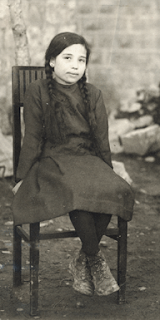
The pictures of children can break your heart. There is Rifka Bachar, a 9-year-old photographed in Jerusalem in November 1923 [see photograph above]. The child has long black hair that hangs in two neat braids, and wears a simple dark dress with long sleeves. She sits on a chair that leaves her legs dangling, with her feet crossed at the ankles. There are high-laced shoes on her feet. Her arms are pressed to her sides, and she grips the seat of the chair, a sign of the tension she feels. Bachar is pretty, with regular features, and looks up at the camera with a somewhat skeptical cast on her face. From the caption we learn she lives with her mother and two sisters in one small room. A brother is in an orphanage. Her father was drafted by the Turks and died of tuberculosis. Her mother is sick and cannot work. The sisters are learning trades with the help of the Palestine Orphan Committee, but do not work yet. We are told, “Rifka is modest, well behaved, fond of learning, and quite an interesting child.”
 Other pictures from pre-state Israel include one from 1921 labeled “A blind girl examines a wall map at the Jewish Blind Institute (Beth Chinuch Ivrim) in Jerusalem.” The caption informs us that the teachers, a man and a woman, are both blind. From the same year, “Elderly men learn to weave baskets and mats at a workshop founded by JDC” shows over a dozen men, all with white beards and most wearing tattered robes, in a courtyard weaving piles of reeds into baskets. Many of them pause to face the camera and we notice the assortment of headgear they have on: a newsboy cap, a bowler hat, some berets, a fez, an astrakhan pillbox, a few bowl-like caps. The varied chapeaux are probably markers for the different parts of the world from which they washed up in Jerusalem.
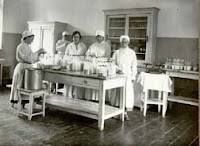 There are many pictures from Europe between the wars. In Poltava, Ukraine, “At a JDC-financed ‘Drop of Milk’ laboratory, women prepare milk for distribution to infants.” Five determined-looking women in white medical uniforms stand by a table covered with bottles of milk in the middle of a conspicuously clean room. A photograph from 1929 shows, “Two women at the old age home subsidized by Kiev’s Jewish Relief Society (KEBO).” Somewhat superfluously the caption tells us, “They have had a hard life, these two.” And, of course, there are many pictures from the havoc of World War II and the dislocations of its aftermath.
June 26, 2009
by William Meyers

The Fortress is a nondescript warehouse building in Long Island City, Queens, where corporations, institutions and individuals store irreplaceable documents and works of art. There is no signage on the building. Inside, past the security check and down a series of spotless corridors, you arrive at the climate-controlled room where for the last five years Peter Goldberg has been digitizing the photographic archives of the American Jewish Joint Distribution Committee. The Joint has almost 100,000 photographs in its collection, of which 24,126 had been scanned by the day I visited the Fortress early in June. With his present technology Goldberg can scan 7,000 pictures a year, so there is plenty of work yet to be done.
Once a picture and its caption have been scanned, it is put back in its acrylic sleeve, returned to whichever of 3,000 lots it came from, and stored in a gray, acid-free cardboard box. The digital file of the image is saved on a hard drive and posted to the Joint’s server; it is then downloaded from the server by the Joint’s archivists in Manhattan for further processing. Slava Mitsel examines the image on his computer screen, categorizes it by date, country, subject, event and photographer, and lists it to a software program that is the core of the archive’s retrieval system. Institutions, moviemakers, writers from all over the world, as well as individuals researching their family histories request images from the Joint, and they are easily located and provided electronically. But the Joint is the primary user of its archive.
Ever since it came into being amidst the carnage and destruction of World War I, the Joint Distribution Committee has used photographs to document its projects. The organization has worked in over 70 countries where dozens of tongues are spoken, but the images provide a common language. They form a record of the crises the Joint has confronted, of the programs it has run to deal with the crises, and — most memorably — of the people involved, both caregivers and recipients.
The pictures of children can break your heart. There is Rifka Bachar, a 9-year-old photographed in Jerusalem in November 1923 [see photograph above]. The child has long black hair that hangs in two neat braids, and wears a simple dark dress with long sleeves. She sits on a chair that leaves her legs dangling, with her feet crossed at the ankles. There are high-laced shoes on her feet. Her arms are pressed to her sides, and she grips the seat of the chair, a sign of the tension she feels. Bachar is pretty, with regular features, and looks up at the camera with a somewhat skeptical cast on her face. From the caption we learn she lives with her mother and two sisters in one small room. A brother is in an orphanage. Her father was drafted by the Turks and died of tuberculosis. Her mother is sick and cannot work. The sisters are learning trades with the help of the Palestine Orphan Committee, but do not work yet. We are told, “Rifka is modest, well behaved, fond of learning, and quite an interesting child.”
 Other pictures from pre-state Israel include one from 1921 labeled “A blind girl examines a wall map at the Jewish Blind Institute (Beth Chinuch Ivrim) in Jerusalem.” The caption informs us that the teachers, a man and a woman, are both blind. From the same year, “Elderly men learn to weave baskets and mats at a workshop founded by JDC” shows over a dozen men, all with white beards and most wearing tattered robes, in a courtyard weaving piles of reeds into baskets. Many of them pause to face the camera and we notice the assortment of headgear they have on: a newsboy cap, a bowler hat, some berets, a fez, an astrakhan pillbox, a few bowl-like caps. The varied chapeaux are probably markers for the different parts of the world from which they washed up in Jerusalem.There are many pictures from Europe between the wars. In Poltava, Ukraine, “At a JDC-financed ‘Drop of Milk’ laboratory, women prepare milk for distribution to infants.” Five determined-looking women in white medical uniforms stand by a table covered with bottles of milk in the middle of a conspicuously clean room. A photograph from 1929 shows, “Two women at the old age home subsidized by Kiev’s Jewish Relief Society (KEBO).” Somewhat superfluously the caption tells us, “They have had a hard life, these two.” And, of course, there are many pictures from the havoc of World War II and the dislocations of its aftermath.
 In the last few decades most of the photographs the Joint has collected have been in color, and the more recent ones were taken on digital cameras rather than film, but the early black-and-white images, some of them made on glass-plate negatives, seem to have greater resonance. In spite of the horrendous conditions they illustrate, the pictures themselves frequently possess great charm. They draw us into the lives and circumstances of these orphans and widows, the maimed and indigent, victims of history. The Joint has employed many exceptional photographers, most famously Roman Vishniac in the late 1930s, but the high quality of the work produced even by anonymous photographers is conspicuous.
The JDC archives are a valuable heritage of the Jewish people, and I am glad the original prints are secure in the Fortress in Queens. For the same reason, I am glad it is the Joint’s eventual intention to make all the digitized images available online.
William Meyers is a writer and photographer, whose photographs are in the collections of the New York Public Library, the Museum of the City of New York and the New-York Historical Society. He writes a column on photography for the Wall Street Journal.
Subscribe to:
Posts (Atom)