Showing posts with label Jewish Continuity. Show all posts

October 22, 2013

JDC Supporters Join Together To Create Impact Network

Several years ago, Jon Deaner traveled to Argentina on a UJA-Federation of New York-led mission with other young professionals to learn about Jewish life and tradition. Among the most moving experiences he had was his visit to a JDC day care program called Baby Help where he met young children living in poverty.

Jon Deaner poses for a photo with children in Argentina.
A photographer, Jon captured his visit in beautiful pictures. But as his initial connections to the children faded with the passage of time, it was that tangible feeling of being involved and making a difference Jon sought to replicate in a brand-new initiative at JDC. 

At about the same time, Doron Goldstein -- the son of JDC Board Member Yoine Goldstein and one of the founders of Entwine, JDC’s young Jewish leadership platform -- was looking to transition from Entwine but remain actively involved with JDC.

Doron grew up traveling all over the world, meeting Jewish leaders from different communities and witnessing firsthand the lifesaving work of JDC.  He understood the only way to be an instrumental player in JDC’s work was to engage head-on with program directors and content. 

Together, Jon and Doron founded the first donor group under JDC Ambassadors. At a membership level of $2,500, the Impact Network model provides access to JDC Ambassadors events and engagement. Group members focus on a particular issue under JDC’s purview and then commit to raising funds for a project they believe in.

All of this comes as no surprise in 2013. Jewish philanthropy research shows new donors are excited to be involved in charitable causes. Many serve on non-profit boards, encourage friends to give and donate online; and once they are hooked, they want to go “all in.” 

“They want to develop close relationships with the organizations or causes they support; they want to listen and offer their own professional or personal talents, all in order to solve problems together with those whom they support,” the research sats. Jon and Doron’s desire to “be information-driven, impact-focused, proactive, and peer-oriented” spoke to all members of the Child Intervention Impact Network.
Under Jon and Doron’s leadership, the group chose to learn about JDC’s involvement in early childhood programming and voted to support JDC’s Baby Help in Argentina. They met over Argentine wine and discussed Argentine history and politics; they learned about Baby Help from the director, Viviana Bendersky; they asked early childhood experts based in New York about the most up-to-date practices. They plan to support Baby Help concretely by purchasing vaccines and meals, raising awareness and communicating new trends in care. The bottom line: They are strategic philanthropists.

Following this idea, other groups have formed using the Impact Network model focusing in an issue of their choice. JDC is looking forward to engaging individuals more directly and giving donors the opportunity to be hands-on involved. To learn more about or join JDC Impact Networks, visit: http://www.jdc.org/impact. 

This blog post features information from pages 11-16 from the report Next Gen Donors: The Future of Jewish Giving.

April 22, 2013

Poland: 70 Years Later

by Rebecca Neuwirth

In the end, it’s Agatha who makes it impossible not to hope.

I’m with a JDC Ambassadors delegation at the 70th anniversary commemoration of the Warsaw Ghetto Uprising. At midnight on April 19, in the light of two flames that rise from menorahs on either side of the famed Ghetto monument, Cantor Yaakov Lemmer sings in Yiddish about small boys who steal outside to sell cigarettes, and of a searing loss of innocence. Next to me, a member of our delegation sings quietly along—she remembers the tune from childhood.
A memorial for children at the 
Jewish cemetery in Warsaw.
Children's Memorial in Warsaw Jewish Cemetary

Loss of innocence is an elegant metaphor for the brutal desperation that drove parents to allow their young boys to risk their lives to bring home crumbs. The story of the Warsaw Ghetto is unendingly heinous. At its height, over 400,000 Jews were imprisioned in 1.3 square miles. Starvation and violence killed some 100,000 in the first year, and the Nazis deported almost 300,000 to mass murder in Treblinka. Cruel selections separated mothers and fathers from their children; sadistic and senseless acts were the rule, with human kindness used as a lure for brutality.

But the commemoration of the Warsaw Ghetto Uprising, unlike other forms of Holocaust remembrance, focuses not on atrocities but on courage.

It draws attention to acts of resistance and stubborn humanity, from the courage of small boys to the sharing of crumbs of food, the caring for orphaned children – embodied by the amazing Janusz Korczak, even the creation of culture that persisted in the Ghetto in the face of inhuman conditions. Above all, it focuses on the final armed resistance waged by a few thousand Jews against the impossibly larger, full force of the Nazis, and that ended one month later in total destruction and with only 13 Jews remaining.

February 19, 2013

Jewish Renewal in Kazakhstan

Hesed Center with young Kazakh Jews.
by Dov Ben-Shimon

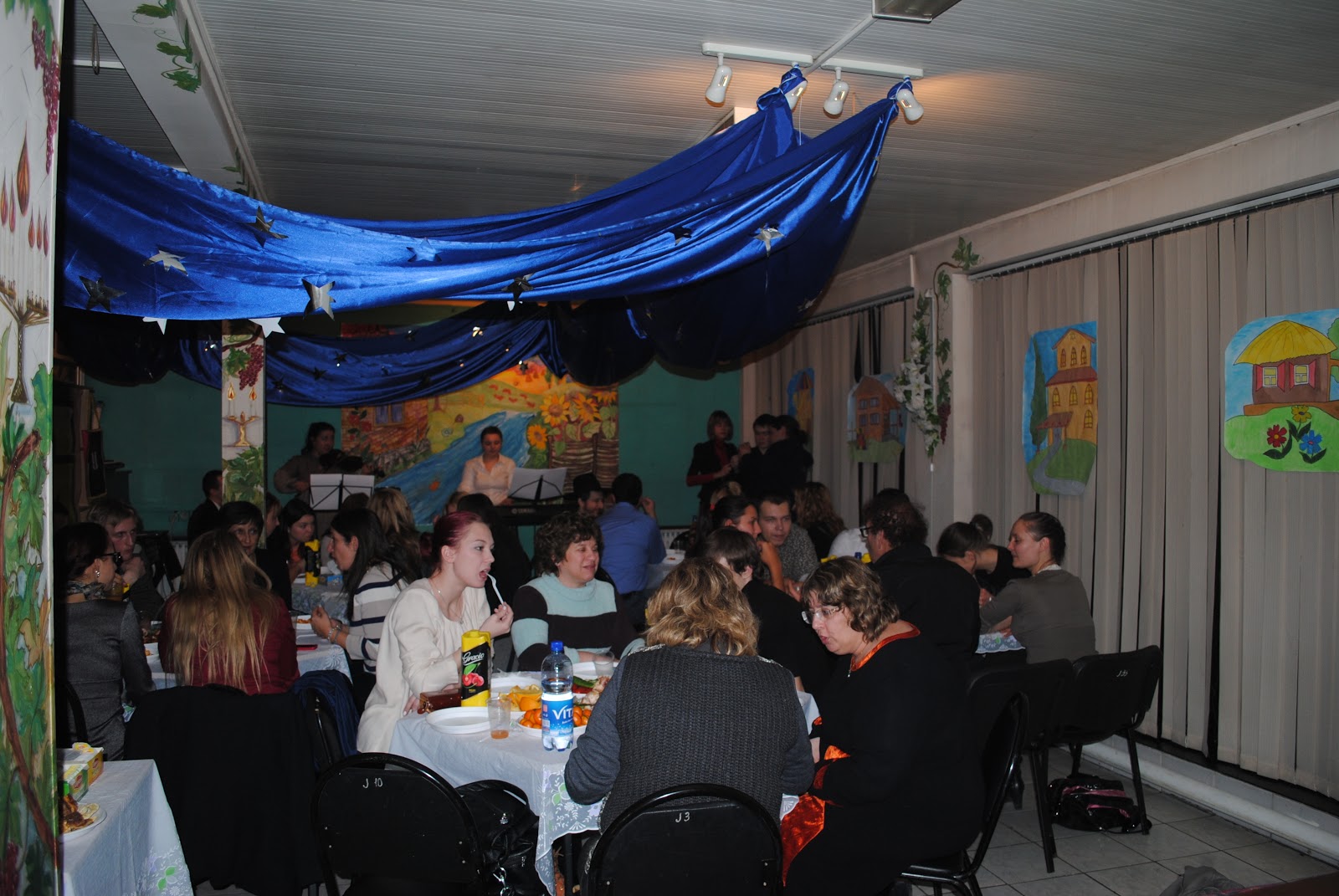
"Yulia" -- dressed in orange
I've just spent the last week in Turkey and Kazakhstan on a JDC Strategic Partnerships/Ambassadors Circle mission and wanted to share something that made a deep impression on me.

At dinner the other night in Almaty, Kazakhstan, I sat with two young leaders of the Jewish community. Michael  and his wife Yelena are very involved with the Almaty community. He is a building contractor and she is a graphic designer. They're both in their early forties and they both volunteer in the Hesed, our federation-supported welfare center. In Almaty the Hesed also functions as a JCC, and they sit on the Board.

Here's the story: Michael grew up knowing he was Jewish. It wasn't a particularly significant part of his life. His mother actually listed their nationality as "Ukrainian" rather than "Jewish" on their internal Soviet passports. She had lived through nasty anti-Semitic attacks in Ukraine before the family moved to Kazakhstan, which has a low level of anti-Semitism. When Michael and Yelena married, religion wasn't really an important topic for either of them, and in a country in which there are high levels of intermarriage, he thought nothing of marrying a nice non-Jewish girl like Yelena.

December 4, 2012

What is our Global Jewish Responsibility?


Peter J. RubinsteinRemarks by Rabbi Peter J. Rubinstein, Senior Rabbi, Central Synagogue
Delivered at the JDC Ambassadors Global Symposium
December 3, 2012

It is a tremendous honor to be with you this morning and a special joy to personally salute you who are involved in and support the JDC.  In my mind you are responsible for and further the work of one of the great heroic organizations of Jewish life. To say this is not hyperbole because I have seen your work in action around much of this world.

Perhaps the most personally stunning and surprising experience I had with JDC was when in the late 1990’s I travelled with a small group of Jewish leaders to visit an Albanian refugee camp during the height of the Kosovo conflict and then to take some of those refugees with us to Israel. In those days brutalized refugees were flowing across the border seeking food and water and shelter and refuge.

I’m not sure what I expected when I arrived in Albania but a tent with a JDC sign outside was nowhere on my screen of possibilities. It was there and then that I came to understand the expansive theater of JDC operations which combat the results of human warfare and misery and are on the ground in the face of the most horrendous natural disasters as in Haiti after the earthquake. I comprehend the exquisite purity of an organization which has as its focus saving people in extremis no matter what their national origin, race, religion or gender. For that I salute and thank you.

The topic you have asked me to address is “What is our Global Jewish Responsibility?” In forming this question I suspect the planners of this symposium were purposeful in framing the question with inherent ambiguity for in fact this topic properly raises two very separate issues.

May 23, 2012

Traveling to Kiev with JDC


Kiev is a vast city of nearly 3 million. JDC's work feeds impoverished Holocaust survivors and other elderly, and helps families in need. It is also about building a caring community, and we felt an integral part of one during our visit.

by Rebecca Neuwirth, Director, JDC Ambassadors

Before leaving for Kiev, someone told me that the city was beautiful, all orthodox churches and Dostoyevsky. And in JDC reports, I read about the immense poverty and dire living conditions of families with troubled children and the elderly.

Not surprisingly, on the first day of our staff mission in Kiev, it seems all of this is true. A city of contradictions, a vast city, vital, sad, moving, with a future that is very uncertain.

April 4, 2012

Young Teacher Promotes Jewish Continuity in Ancient Community

At a JDC-supported girls' school in Zarzis,
Tunisia, students get the unique opportunity to
study Judaism, Torah, Talmud, and Hebrew.
Photo: Chrystie Sherman (via JDC Website)
Geula is 21, born and raised in Djerba, Tunisia, to a Jewish family whose roots here go back for centuries. But in the spirit of the times—and her country—she isn't spending much time looking at the past. Instead, she sets her sights on her work as a teacher, equipping her female students with the tools to be the next link in the unbroken chain she believes makes her community special.

"I think it is very important to be a teacher. I see myself as a leader and a guide to my students," says Geula. "Parents give life; teachers give knowledge. I take a lot of pride in fulfilling my role."

Geula teaches at Torah v'Hinuch, the first Jewish girls' school in Djerba that was founded in the 1950s. Today approximately 130 girls are enrolled in the school, where she teaches Judaism, Torah, Talmud, and Hebrew. Students attend class six days a week, getting time off only on Jewish calendar holidays; there is no summer vacation.