Showing posts with label Jewish Renewal. Show all posts

May 9, 2013

Making the Connection: JDC's Ambassadors Symposium

Making the Connection was the theme of the JDC Ambassadors Symposium, May 6-7, focusing on how we can make a genuine and meaningful connection between us as caregivers and philanthropists and the people in need around the world that we help. 

The ideal connection would look very different from the top-down approach that too often has served to increase the divide among people. It would be about achieving true empathy, about empowering the people we help so that they are the best allies in helping themselves, and about stretching how we do philanthropy and engage others.

Monday's session looked at how we care for our friends as a model for how we do good in the world.

Park Avenue Synagogue’s Rabbi Cosgrove spoke about empathy and the Hebrew concept of arevut, the responsibility we have towards one another (click here). Letty Cottin Pogrebin spoke about her personal experience fighting breast cancer and the type of care that she sought from friends and family, and articulated principles that resonated with her experience and others' with whom she spoke. Foremost among them was the importance of listening to the voices and wishes of the people we want to help and not assuming that we know best.         

What might this principle look like if we put it into play in our humanitarian work as well as our personal lives?

There are few programs that better demonstrate JDC's vision of listening to and empowering the people we serve than Jay Ruderman’s groundbreaking work with disabled people in Israel -- a partnership among his family foundation, JDC and the Government of Israel that goes by the name Israel Unlimited.  A staggering 1 million people suffer from disabilities in Israel (key stats here), but the program does not focus on accessibility alone. Instead, it makes disabled people the actors in their own story -- helping them to challenge stigmatization (here's an excellent piece on an inspiring blind Arab Israeli woman) and build up their confidence and abilities to act as positive forces in their communities through volunteerism and a new emphasis on work.
 

April 22, 2013

Poland: 70 Years Later

by Rebecca Neuwirth

In the end, it’s Agatha who makes it impossible not to hope.

I’m with a JDC Ambassadors delegation at the 70th anniversary commemoration of the Warsaw Ghetto Uprising. At midnight on April 19, in the light of two flames that rise from menorahs on either side of the famed Ghetto monument, Cantor Yaakov Lemmer sings in Yiddish about small boys who steal outside to sell cigarettes, and of a searing loss of innocence. Next to me, a member of our delegation sings quietly along—she remembers the tune from childhood.
A memorial for children at the 
Jewish cemetery in Warsaw.
Children's Memorial in Warsaw Jewish Cemetary

Loss of innocence is an elegant metaphor for the brutal desperation that drove parents to allow their young boys to risk their lives to bring home crumbs. The story of the Warsaw Ghetto is unendingly heinous. At its height, over 400,000 Jews were imprisioned in 1.3 square miles. Starvation and violence killed some 100,000 in the first year, and the Nazis deported almost 300,000 to mass murder in Treblinka. Cruel selections separated mothers and fathers from their children; sadistic and senseless acts were the rule, with human kindness used as a lure for brutality.

But the commemoration of the Warsaw Ghetto Uprising, unlike other forms of Holocaust remembrance, focuses not on atrocities but on courage.

It draws attention to acts of resistance and stubborn humanity, from the courage of small boys to the sharing of crumbs of food, the caring for orphaned children – embodied by the amazing Janusz Korczak, even the creation of culture that persisted in the Ghetto in the face of inhuman conditions. Above all, it focuses on the final armed resistance waged by a few thousand Jews against the impossibly larger, full force of the Nazis, and that ended one month later in total destruction and with only 13 Jews remaining.

February 19, 2013

Jewish Renewal in Kazakhstan

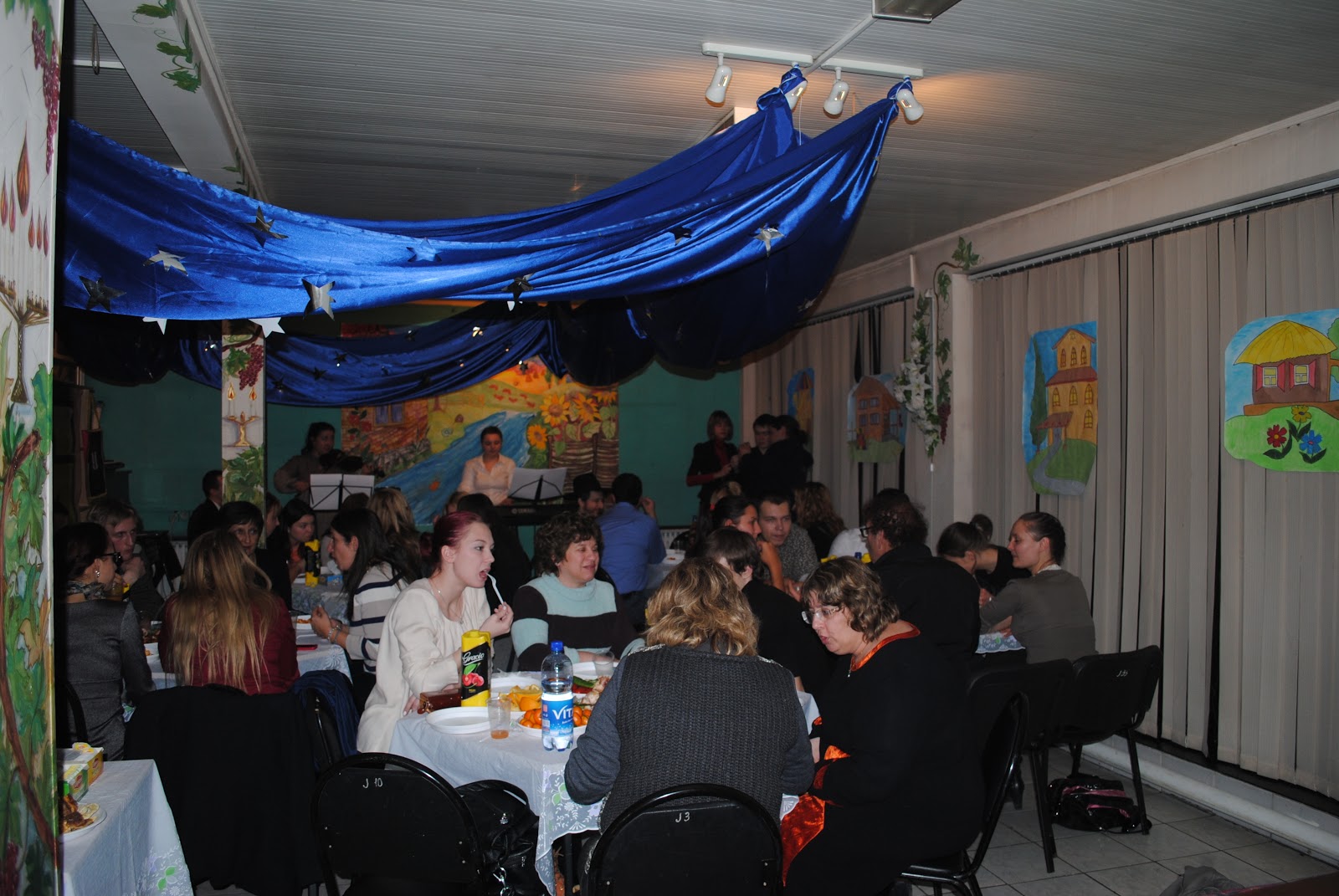
Hesed Center with young Kazakh Jews.
by Dov Ben-Shimon

"Yulia" -- dressed in orange
I've just spent the last week in Turkey and Kazakhstan on a JDC Strategic Partnerships/Ambassadors Circle mission and wanted to share something that made a deep impression on me.

At dinner the other night in Almaty, Kazakhstan, I sat with two young leaders of the Jewish community. Michael  and his wife Yelena are very involved with the Almaty community. He is a building contractor and she is a graphic designer. They're both in their early forties and they both volunteer in the Hesed, our federation-supported welfare center. In Almaty the Hesed also functions as a JCC, and they sit on the Board.

Here's the story: Michael grew up knowing he was Jewish. It wasn't a particularly significant part of his life. His mother actually listed their nationality as "Ukrainian" rather than "Jewish" on their internal Soviet passports. She had lived through nasty anti-Semitic attacks in Ukraine before the family moved to Kazakhstan, which has a low level of anti-Semitism. When Michael and Yelena married, religion wasn't really an important topic for either of them, and in a country in which there are high levels of intermarriage, he thought nothing of marrying a nice non-Jewish girl like Yelena.

December 4, 2012

What is our Global Jewish Responsibility?


Peter J. RubinsteinRemarks by Rabbi Peter J. Rubinstein, Senior Rabbi, Central Synagogue
Delivered at the JDC Ambassadors Global Symposium
December 3, 2012

It is a tremendous honor to be with you this morning and a special joy to personally salute you who are involved in and support the JDC.  In my mind you are responsible for and further the work of one of the great heroic organizations of Jewish life. To say this is not hyperbole because I have seen your work in action around much of this world.

Perhaps the most personally stunning and surprising experience I had with JDC was when in the late 1990’s I travelled with a small group of Jewish leaders to visit an Albanian refugee camp during the height of the Kosovo conflict and then to take some of those refugees with us to Israel. In those days brutalized refugees were flowing across the border seeking food and water and shelter and refuge.

I’m not sure what I expected when I arrived in Albania but a tent with a JDC sign outside was nowhere on my screen of possibilities. It was there and then that I came to understand the expansive theater of JDC operations which combat the results of human warfare and misery and are on the ground in the face of the most horrendous natural disasters as in Haiti after the earthquake. I comprehend the exquisite purity of an organization which has as its focus saving people in extremis no matter what their national origin, race, religion or gender. For that I salute and thank you.

The topic you have asked me to address is “What is our Global Jewish Responsibility?” In forming this question I suspect the planners of this symposium were purposeful in framing the question with inherent ambiguity for in fact this topic properly raises two very separate issues.

October 22, 2012

JDC Ambassadors Global Symposium, December 3

The Jewish Future:
New Strategies for Sustaining and Inspiring Jewish Life

New York City

Guest Speakers:
Peter J. Rubinstein, Senior Rabbi of New York's Central Synagogue
Anne Heyman, Founder & Board Chair - Agahozo-Shalom Youth Village
Jack Habib, Director, Myers-JDC-Brookdale Institute
and more...

FOR MORE INFORMATION -- go to http://jdc.org/ambassadorssymposium

JDC has worked for almost 100 years in supporting Jewish life around the world. But even as we help individuals and communities deal with crisis and handle extreme poverty on a day-to-day basis, our middle and long-term aims are more elevated and strategic: to ensure robust and inspired Jewish communities that care for one another.

The December 3 Ambassadors Symposium examines the Jewish future. How can we support small, vulnerable Jewish minorities in Muslim countries against the backdrop of the Arab spring and heightened global tensions? And, how can we share successful local Jewish and Israeli program models of care with other communities and the larger world – as a way to build bridges, scale impact, and fulfill our mandate of tikkun olam, or healing the world.

Peter J. Rubinstein, Senior Rabbi of New York's Central Synagogue, will offer a keynote address on what global responsibility really means today.

The Symposium will also introduce a new feature: JDC Think Tank sessions, which will allow key leadership to “roll up their sleeves” with participants to address current open questions on the spectrum of JDC’s work. Roundtable discussions will range from maximizing renewal activities in the increasingly trendy city of St. Petersburg, Russia to inspiring young American Jews to embrace a global and Jewish tikkun olam agenda, and more.

___

JDC Ambassadors Symposia provide in-depth opportunities to understand how the latest global events are impacting Jewish communities around the world – and what we can do about it. Symposia are open to JDC Ambassadors, members of our Ambassador Circle and Society, and select guests.

September 6, 2012

Bringing a Sweet New Year to Families in the Crimea

With their local Hesed now a second home,
Vika, her sister, and her mom know they won’t
be alone this Rosh Hashanah.
Photo:  JDC Website

Six-year-old Vika, her sister Vera, 11, and her mom, Olga celebrated their very first Rosh Hashanah last year.

Since then, they’ve come to call the Jewish community in Feodosiya, their native town in the Crimea, a second home. For this single-parent family, Jewish life has become a much-needed anchor in their otherwise tumultuous existence. This year they couldn’t be more excited to visit their localHesed social welfare center for communal festivities and honey cake.

Olga grew up under communism, when religious practices were outlawed and Jewish life was hushed for decades. She never learned any Jewish history or traditions in her home as a child; when she became a mom, she had none to pass on to her daughters.

July 12, 2012

Camping in Belarus Brings Families to Jewish Community


This summer Pavel will be among thousands 
of Jews participating in JDC-supported day 
camps, family retreats, and intergenerational 
Shabbatons taking place throughout the 
former Soviet Union.
Mirroring a common reaction among fellow Jewish 10-year-olds in Minsk, Belarus, Pavel’s eyes light up with excitement at the mere mention of “Shemesh” Camp at his local Jewish Community Center (JCC). That’s because Pavel can’t wait to join his friends for a 10-day session of fun and Jewish learning that will include trips to parks, museums, movies, and other attractions around Minsk.

With hundreds of kids and families attending the Minsk JCC annual summer program, Jewish camping has become the new “in vogue” thing to do in the Belarusian capital.

For the past 20 years, JDC has exponentially expanded opportunities for Jews in Belarus and across the former Soviet Union (FSU) to connect with their local communities. In the process, Jewish camping has become a premier outreach activity, bringing together kids and families eager to take a holiday with rich Jewish content and offering a gateway into Jewish life year-round at Minsk’s JCC Emunah.

June 11, 2012

JDC Ambassadors In Cuba


JDC Ambassadors Mission to Cuba
on the steps of the Patronato Synagogue in Havana

By Dov Ben-Shimon, JDC Executive Director of Strategic Partnerships

I've just spent the last weekend staffing the JDC Ambassadors Circle Mission to Cuba, to see the amazing Jewish community there, learn about our challenges and horizons, and participate in some unique experiences. I've been to Cuba many times to show JDC supporters and Ambassadors the work we do, and each time I see new and inspiring aspects of our work.

This time, three special aspects stood out:


May 23, 2012

Traveling to Kiev with JDC


Kiev is a vast city of nearly 3 million. JDC's work feeds impoverished Holocaust survivors and other elderly, and helps families in need. It is also about building a caring community, and we felt an integral part of one during our visit.

by Rebecca Neuwirth, Director, JDC Ambassadors

Before leaving for Kiev, someone told me that the city was beautiful, all orthodox churches and Dostoyevsky. And in JDC reports, I read about the immense poverty and dire living conditions of families with troubled children and the elderly.

Not surprisingly, on the first day of our staff mission in Kiev, it seems all of this is true. A city of contradictions, a vast city, vital, sad, moving, with a future that is very uncertain.

April 5, 2012

Passover Inspires Volunteerism in Belarus

Simon G., 18, is one of hundreds of grassroots
volunteers leading Seders in JDC-supported
centers throughout the former Soviet Union 
this Passover.
“I remember our family receiving support from the Jewish community when I was three or four years old. Now I finally get the chance to give back,” says Marina L., who at 17 years old is leading her first Seder—a community holiday celebration for children and families at the Minsk Jewish Campus.

Marina is an only child. She shares a rundown two-room flat in Minsk, Belarus with her parents, both of whom are disabled and struggle to subsist on a monthly pension. The Jewish community has been this family’s lifeline since Marina was a young girl. In addition to providing her with basic food and medicines, JDC has enabled Marina to attend Jewish camp, participate in Hillel activities, and attend myriad programs at the local JDC-supported Jewish Community Center (JCC).

“Every trip, every event organized by the Jewish community, has been unforgettable for me … full of vivid impressions and memories,” she said.

January 31, 2012

Hallmark Jewish Renewal in the Heart of Eastern Europe


Discover the new chapter of a two-millennia-old story about Bulgaria, where JDC is helping this once-thriving Jewish community, nearly silenced by war and communism, create a remarkable renaissance.

December 21, 2011

From Moscow - Chanukah Torch Relay

Hillel Moscow held a torch relay last night through the center of the city for the lighting of the first candle to usher in the Festival of Lights.


Hillel Moscow Hanukkah Torch Relay 2011 from Valentin Scutaru on Vimeo.

December 2, 2011

Poland’s Largest Jewish Gathering is Youth Inspired and Volunteer Led

Volunteer-organized Limmud Keshet in Poland
brings together hundreds of Jews young
and old for a weekend of fun and Jewish learning
Anna is a poster child for her community's campaign about Jews in Poland. With a Jewish mother who knew little about her roots (she had no one to learn from) and a non-Jewish father, Judaism was not a part of Anna's family life when she was a child.

But around the time she turned 16 something changed. Her mom met a friend who introduced her to the growing Polish Jewish community, which she was surprised—and very pleased—to discover. Soon she started taking Yiddish classes and coming to events and holidays at the Jewish Community Center. And Anna, excited to connect with her mom and reconnect with their ancestry, came along, too.

Anna joined the Jewish student organization and soon found herself on a Taglit trip to Israel. "For me, that was transformative. I felt grateful for the experience and wanted to do something in the community to show my appreciation," said Anna. "I became a volunteer and started to feel needed and useful. I found the place where I felt at home."

So when JDC brought Limmud—a pluralistic, volunteer-organized learning initiative that's active today in over 50 countries—to Poland four years ago, Anna was among the first to get involved. And it didn't take long for her mother to join her and become a Limmud volunteer herself.

For three years running, Limmud Keszet Poland has been the largest gathering of Polish Jews in the country since the late 1960s. Over 600 participants took part last year and this year the same number of spaces sold out within 24 hours of the event's announcement.

But what makes Limmud Keszet significant is more than just numbers; it is the fact that this volunteer-led event draws Jews of all ages (from 6 months to 90 years old), of all denominations and traditions (from Orthodox to Progressive), and from a variety of linguistic backgrounds (Polish, Hebrew, Yiddish, and English) together for a weekend of fun and learning. In short, there's simply nothing else like it on the Polish-Jewish calendar.

Volunteers organize over 100 lectures and workshops led by world-famous scholars, artists, rabbis, and fellow community members. There is something for everybody: arts and crafts workshops for children, cooking classes, dance lessons, discussions on Jewish philosophy and the Torah. At Limmud, everyone shares his or her areas of expertise with the community.

For Anna, volunteering at Limmud is very special because it connects such an eclectic group of people. "Nowhere else in Poland can you meet so many Jews in one place. Nowhere else will you find everyone—Orthodox, Reform, professors and "beginner Jews"—coming to celebrate Shabbat together."

Monika, the event's organizer, says Limmud is chiefly about "breaking barriers by bringing elements of the entire community together"—something that is particularly hard to do given the history of Polish Jewry, in which barriers often formed important protections but also kept the community fragmented. "Limmud is our ideal vision of what we as a Jewish community would like to be: united and sharing in the joys of practicing and learning about our tradition…and planning for a better future."

Through events like Limmud, young Jews from across Poland are getting involved and ensuring the focus of Jewish life in their country remains modern and forward-looking. Anna, who is a Jewish professional today, is proud to play an active role in her community's growth and evolution. "My peers are choosing to raise their children Jewish. That's already a step that will pay off in the future!"

November 22, 2011

Family Retreats Offer a Helping Hand to Special Needs Kids and Their Parents

Integration camps for families with children with
special needs provide tailored services and care
and offer a welcoming community and entry point into
Jewish life.
Photo: JDC Website
For Vladimir and Irina, everyday parenting is a struggle. Both of their young children suffer from debilitating illnesses: Nikita, 8, has cerebral paralysis; his legs do not work, so he can’t move without his parents’ help and his speech is also severely impaired. Ellina is five, and soon after she was born her parents learned that she had encephalopathy (brain disease/disorder) and would require ongoing medical attention throughout her life.

The difficulty of meeting their children’s special needs is confounded by the pressures of making ends meet on the family’s meager $200 monthly income. The children require regular doctors’ visits, treatments, medications, and nutritious food—but the household utilities alone cost over $100 per month.

Strained, isolated, and overwhelmed, Vladimir and Irina have no public resources to turn to for help—which is why JDC’s assistance is so critical. They receive food and medicines, diapers, clothes, and household supplies to help them meet their basic needs. They rely on special packages of food and Jewish items in order to celebrate the holidays. But the family has found its greatest assistance in the community and support that embraced them at this year’s JDC Family Integration Camp just outside their hometown of Kishinev, Moldova.

“Other families with kids with special needs can understand the hardships, pain, and fears that go along with raising children with disabilities and help us feel less alone,” Irina says.

JDC supports family camping programs throughout Moldova, Ukraine, Belarus, and Russia. Over 5500 people will participate in intergenerational camps, Shabbatons, and retreats throughout the region this year. Integrated family camps are unique as they are staffed by specially trained madrichim as well as psychologists, medical doctors, and specialists for children with special needs. They provide an environment where parents and children alike can receive tailored assistance and take part in sensitive programming designed to make the most of their children’s abilities and talents.

Families take part in Jewish activities (like decorating hamsas, kippot, and Shabbat candles), and everyone comes together as one big family to celebrate Shabbat and then to sing Havdalah songs as Shabbat draws to a close. For many, these programs offer the only chance to connect with other families in the disability community and to find an entry point into Jewish life.

This is just what happened to the Shoob family: Eugene, 50, is a single father to Lubov, his ten-year-old daughter who suffers from cerebral spastic infantile paralysis. They didn’t think other families would understand their trying circumstances so they’d never taken part in community activities until last year, when when they participated in the family camp in Minsk, Belarus.

“The days we spent at the Jewish family retreat were unforgettable,” Eugene reflects. “Initially, I went for the sake of my daughter but I learned so much myself. Lubov found new friends at camp and came back proud to be part of the Jewish people. I’d thought it was hardly possible to find like-minded people at my age but found out just how wrong I was.”

Today Eugene and Lubov take part in their local family club and the Mishpacha (Family) theatre program, and attend all of the community’s holidays, concerts, festivals, and activities. They’ve started going to synagogue and Lubov now attends the JDC-supported Minsk Jewish Community Center programs where she plays, dances, and has made many friends. Eugene is very grateful for his newfound community and cannot wait to for this year’s retreat.

“I have always known my family is Jewish,” he said. “But now I know what that means and what a joy it can be.”

October 17, 2011

Op-Ed by JDC CEO Featured in Wall Street Journal

JDC's CEO Steve Schwager wrote a wonderful op-ed that recently appeared in the Wall Steet Journal 'Houses of Worship' column in the Editorials section. 

You can read the article on the Wall Street Journal Website

Wall Street Journal -- HOUSES OF WORSHIP
OCTOBER 14, 2011

A Miraculous Post-Soviet Religious Revival

Jewish practice has come a long way since owning a Russian copy of Leon Uris's "Exodus" could land a Jew in jail.

By STEVEN SCHWAGER

As Jews around the world gather to celebrate Simchat Torah next week—the raucous holiday marking the completion of the annual cycle of public Torah readings—I am reminded of one of the more curious practices among Soviet Jews in the final decades of the Communist regime.

Living under duress, these Jews gathered illegally in homes or even in the streets to celebrate a holiday for an object that most had never seen, let alone read from. Such celebrations persisted despite systematic anti-Jewish persecution by the Soviets, including university quotas, discouragement from certain jobs, and an all-out effort to eradicate Jewish culture and religion.

And yet 20 years after the Soviet Union's fall, this act of defiance has taken on an entirely different character. That's because—contrary to all expectations—we are in the midst of one of world's more miraculous revivals of Jewish civilization, and in much of the former Soviet Union such celebrations are no longer taboo. In fact a million or so Jews in former Soviet states are now celebrating their faith, history and culture with an enthusiasm previously unimaginable.

I credit this renaissance to two main forces.

First, and perhaps most extraordinary: the resilience of Jews whether in Ashkabad, Chisinau or Tbilisi. After the tsars and the Soviets, they cautiously embraced their new freedom and began to explore, on their terms, what it meant to be a Jew in an open society.

Second: the indefatigable efforts of American Jews and Jewish organizations. My organization, the Joint Distribution Committee, was actually described by Stalin's prosecutors as the "international bourgeois Jewish-Zionist organization" allegedly behind the notorious "Doctors' Plot" of 1953.

In reality, of course, the plot was a Stalinist fabrication and a pretense for anti-Semitic propaganda, show trials and executions. Nonetheless, we and many others continued our secret work in the Soviet Union. Then in 1991 we openly continued in the new states that emerged, with hands full of instruments of Jewish knowledge and tradition, helping to recreate Jewish life.

The quest for Jewish knowledge and community life, pa Ruski, is tangible among people grappling with the challenges of post-Soviet societies. And yet not only can Jews of all ages pray in a variety of synagogues—from Chabad to Reform congregations—they can also engage in bar and bat mitzvah retreats in the hinterlands of Siberia. In Hebrew and Russian prayer books, religious schools and even online, in the world's first Russian-language Jewish education guide, they are learning about the Jewish New Year, the Torah, Israel, Passover and the mitzvot (commandments) that make up Jewish life.

In almost 200 Jewish Community Centers, music, art, dance and more lead to creative expressions of identity. As Moscow suffered from soaring temperatures and nearby forest fires two summers ago, young Jews at the local JCC—who inherited a society that eschewed modern philanthropy—led an unprecedented Facebook campaign to deliver food, fans and comforting words to the community's poor and elderly.

In the public square, 200 Jewish libraries containing more than a million Jewish books complement the Jewish Studies courses at more than 100 universities in the post-Soviet region. In 16 Hillel centers, meanwhile, thousands of Jewish students are embracing their identity and wearing it publicly. Such pride was evident when Vladimir Goodkov, the Jewish winner of the popular Ukrainian Stars Factory program (a version of American Idol), had his friends from his Jewish youth group in Kharkov celebrate Shabbat dinner with him and his co-contestants on Ukrainian National TV.

When asked who inspired his decision to choose a televised Jewish meal over a concert in Cannes or his own CD release, he said: "The way I am now—enthusiastic, not afraid to say anything—is thanks to the people, the community that I became part of."

It is a long journey from the days when owning a book in Hebrew or a Russian-language copy of Leon Uris's "Exodus" was enough to get a Jew sentenced to jail.

Mr. Schwager is CEO of the American Jewish Joint Distribution Committee.

October 7, 2011

Jewish Camping Builds Community across Europe and FSU

 To view the full slideshow of photos from JDC sponsored summer activities in Europe and the FSU, please check out this link. 

Svetlana is raising her little girl Natalia, age 5, alone in a tiny two-room home that has no running water or indoor plumbing, and nothing but an oven to keep them warm in the cold Belarussian winters. Supporting her daughter on a cleaner’s monthly salary of $88 would be excruciatingly difficult under any circumstances; but Natalia’s needs as an epileptic, who also suffers from frequent sinus trouble and adenoid infections, make it impossible.

JDC provides the family with vital help such as heating wood for the winter, and clothing, shoes, and school supplies for Natalia in the fall. But what they both look forward to most of all is summertime, when they can take a break from the harsh reality of their daily lives to attend a JDC Shabbaton for families with children with special needs.

Like thousands of children and parents across Europe and the former Soviet Union, Svetlana and Natalia are thrilled to participate in one of the myriad JDC Jewish camping programs that have been bringing together Jews throughout the region for over 20 years. Active in every season and for every age group—whether regional summer “sleepaways” or day camps for kids; year-round family shabbatons, weekend retreats, or intergenerational camps; madrichim (counselor) training sessions for young leaders; or golden age camps for seniors—these experiences often serve as a powerful entree into Jewish life and a welcome reprieve for those with challenging personal situations like Natalia and Svetlana’s.

This year nearly 15,000 children and adults will participate in JDC’s camp programs, which will include over 130 camps in 20 countries across Central and Eastern Europe and the former Soviet Union.

“Thank you for the well organized event, the attention you gave to our children, the rest for us parents, and the great meals,” wrote Svetlana after participating in a recent Minsk Shabbaton. “We are grateful for the opportunity to participate in such an experience and wish JDC prosperity, success, and the possibility to organize such events in the future.”

August 25, 2011

Reviving Baltic Jewish Communities One Camper at a Time

Irina with eleven-year-old Agata from Latvia,
who has been attending Olameinu summer camp
since age five with assistance from JDC's children
in need program
Photo: JDC website
The great history of the Baltic region as a center of Jewish learning and culture – nearly destroyed by the Holocaust and decades of communist repression – is finding expression once again, with JDC support, in the reemerging Jewish communities of Lithuania, Latvia, and Estonia. Nowhere is this more apparent than at the thriving Olameinu regional Baltic summer camp, where hundreds of Jewish children of all ages eagerly embrace Jewish knowledge and tradition each year.

The personal journey of Irina O., the camp’s 26-year-old director, mirrors the renewal of Jewish life in the Baltics over the past 20 years. Today all Olameinu camps are staffed completely by directors, teachers, and madrichim (counselors) from the local Jewish community. Here’s what Irina had to share about the camp – and about building the new Jewish generation in the Baltics.

Q: Olameinu, now in its 10th year, connects young Jews with one another and with their heritage, building a strong community foundation. When does camp start and how many kids will participate?

A: So far we have 180 registered for Olameinu’s end of July session for kids ages 7-12 in Estonia. In August we expect 180 teens (ages 13-17) for the session in Lithuania and 160 students, ages 18-35, in Latvia.

Also, we have a group of 55 kids from the Baltics leaving for the Ronald S. Lauder Foundation/JDC International Summer Camp at Szarvas, Hungary.

Q: That’s a lot of children getting involved in Jewish life through camping. What was your first exposure to Judaism?

A: My Jewish journey began when I was 12 years old and my parents enrolled me in the Jewish school in Riga, where I completed 6th through 12th grade. Prior to that I knew was that I was Jewish and my mother’s parents lived in Israel (they moved there in 1995) but I didn’t grow up with Jewish traditions in my home because I was from a mixed family – a Jewish mother and Ukrainian father.

Starting Jewish school was really inspiring and changed my life! I started bringing my parents to school for all the Jewish holidays and to synagogue. My parents were happy to go because they figured if it brings the family together, why not?

Q: When did you first get involved in your Jewish community?

A: While still in school I started to volunteer as a leader and was quite successful. I’d never had the experience of being a kid at camp so when I turned 18 I went to Szarvas. I was so impressed that I sought out additional development, including the JDC-supported Kadima (Baltic madrich trainings at the Kadima School for Counselors), then Szarvas madrich training, and the regional Baltics madrich seminars.

Nine years ago I started as a madricha and then became an Olameinu coordinator. Today I’m the Olameinu camp Director and the Youth Program Director in Riga, Latvia.

Q: Your growth as a leader seems to reflect the expansion of programs for youth throughout the Baltics and even the maturity of the Jewish community in the region. What is Riga’s Jewish community like today?

A: I’ve been involved in the Jewish community professionally for eight years and I’ve seen it progress from a variety of disconnected programs to a united organization with common goals and bright leadership. I’ve seen it grow from a small community to a big, vibrant one.

For example, five years ago we had youth programs, elderly programs, programs for children, etc. Now we are all together and it is very nice to be part of something bigger, all under one roof.

Q: What is the balance between JDC’s stewardship and your community’s input into the programs you work on?

A: My team and I work all year long, creating programs for different ages. I coordinate all the youth programs (which covers a big age range, from two to 45!) We have weekly and monthly Jewish cultural programs … for small kids, families, teenagers ... and all are supported by JDC.

Both the community and JDC support our program development. They support our ideas, we jointly come up with the program goals, and then our local staff implements the programs. It’s a very good balance.

Q: With members of the community like you taking the leading role in driving the programs, is there a strong emphasis on developing young leadership to carry the torch in the future?

A: Yes, leadership development is very critical for our community.

When it comes to camping, we have many madrichim that start out in local clubs and local communities and then go on to Olameinu and Szarvas. (We also have kids that go to Szarvas and come back to be madrichim at our camp.) What’s great is that the youngsters feel that they can really contribute, participate, and fully express their ideas at our local camp. This is where they shine and I want to encourage that in every way. I see developing young Jewish leaders as a very important part of the camp that I am running.

Q: What are some of the programs that you are excited about this summer?

A: I’m excited about all of the programs because every single year I try to bring something new into the camps. This time, for example, it will be special for the kids to sing real Israeli songs with our singer from Israel and to learn Israeli rikudim from a dancer we’ve invited from Bulgaria.

This is also the first year that I am leading two of the sessions, so it is a new personal challenge for me. I am very excited about the theme that we chose: the Ten Commandments. Throughout the sessions kids will have a chance to learn about this theme and explore it through arts and crafts, workshops, games, and study sessions with their madrichim.

All in all, I feel very lucky because I get real pleasure from my work, especially when I see the kids smiling, feeling Jewish and joyous. That’s better for me than anything.

August 8, 2011

A visit to Odessa & Beit Grand

Alan Gill, Executive Director, International Relations at JDC, recently spent a day in the field in Odessa and shared his experience on 'Global Impact', THE ASSOCIATED: Jewish Community Federation of Baltimore's overseas blog. 

Read about Alan's day in the field at A Visit to Odessa and Beit Grand.


August 3, 2011

Video: JDC Summer Camp in Szarvas, Hungary


Playing host each summer to approximately 1,350 Jewish campers and counselors from more than 20 countries, the Ronald S. Lauder Foundation-JDC International Summer Camp at Szarvas, Hungary has secured its reputation as a premier and much sought-after informal Jewish educational venue for children from all parts of the Jewish world.

Since its opening in 1990, Szarvas has also succeeded in nurturing a generation of potential Jewish community leaders comfortable with the idea of working together across national borders. Now a year-round facility, the camp has become the venue for Machol Hungaria and for many of the training seminars for madrichim (youth leaders) organized by JDC’s international community development team, and different segments of the Hungarian community have also begun to avail themselves of the legendary “Szarvas experience.”

July 7, 2011

Jewish Renewal Goes Live

With help from JDC's new online educational
resource, Russian-speaking Jews of all ages
and knowledge levels can teach and learn
about Jewish tradition and customs in new,
creative, and innovative ways.
Photo: JDC Website
Anton, a Jewish youth group leader, lives in an Eastern Ukrainian city with few knowledgeable Jews, no Jewish school or library, and a community life that is more enthusiastic than substantive. Despite his eagerness to help local teenagers grappling with what being Jewish means to them personally, Anton struggled with his own rudimentary religious education to put together a program on Jewish identity that would “speak” to young people and involve them personally in the dialogue.

That was some months ago.

Now, with the click of an icon, a world of Jewish information and creative programming—including lessons, games, and activities for all age groups—is open to him. JDC’s Activi, a new 14-volume Russian-language anthology of Jewish knowledge and informal educational materials available online (http://activi.jdc.org.il/) and in print, is an invaluable resource for informal Jewish educators like Anton who are working today in hundreds of cities throughout the FSU, and in Russian-speaking communities worldwide.

Recently unveiled at a three-day JDC educators’ conference in Moscow, the comprehensive series provides the methodology to transmit information about Jewish culture and tradition in ways that are stimulating, engaging, and appropriate for audiences of all ages and backgrounds. It covers a wide range of Jewish topics, from Judaism in the modern world to Jewish holidays to the State of Israel, among many other themes. Articles are written in simple, accessible Russian and aimed at those who have only very basic Jewish knowledge.

The launch conference put Activi’s innovativeness into action. Using an exhibit stand to represent each of the anthology’s 14 volumes, JDC organizers showcased card games about Jewish shtetls, puppet shows on Jewish family life, holiday cooking demonstrations, a workshop recreating a traditional Jewish study hall, a Jewish literary coffee house, theatrical performances, comic strips on Jewish topics, and other creative ideas.

Almost four years in the making, Activi was authored primarily by the Chais Center at Hebrew University, Machanaim, and the Institute of Informal Education headed by Dima and Natasha Zicer. The website is the internet companion to the published 14-volume, 3,000-page compilation, which JDC is distributing to Jewish institutions throughout the former Soviet Union. Publication was supported by the Charles Hoffman Endowment Fund, among others.

Activi is part of JDC’s “Judaism without Walls” initiative, which aims to bring Jewish tradition and culture to people where they are, often in alternative spaces outside of conventional centers of Jewish life. Today, Activi is giving community activists in cities far from the FSU’s major centers of Jewish life the resources to educate, entertain, and inspire their fellow Jews.